Bedside Table Styling: How to Dress a Small Nightstand
A four-part formula for a tiny nightstand: one light, one tall organic piece, one dish for daily items and a book or two, with a third of the top left clear. Includes wall-light and no-table options.
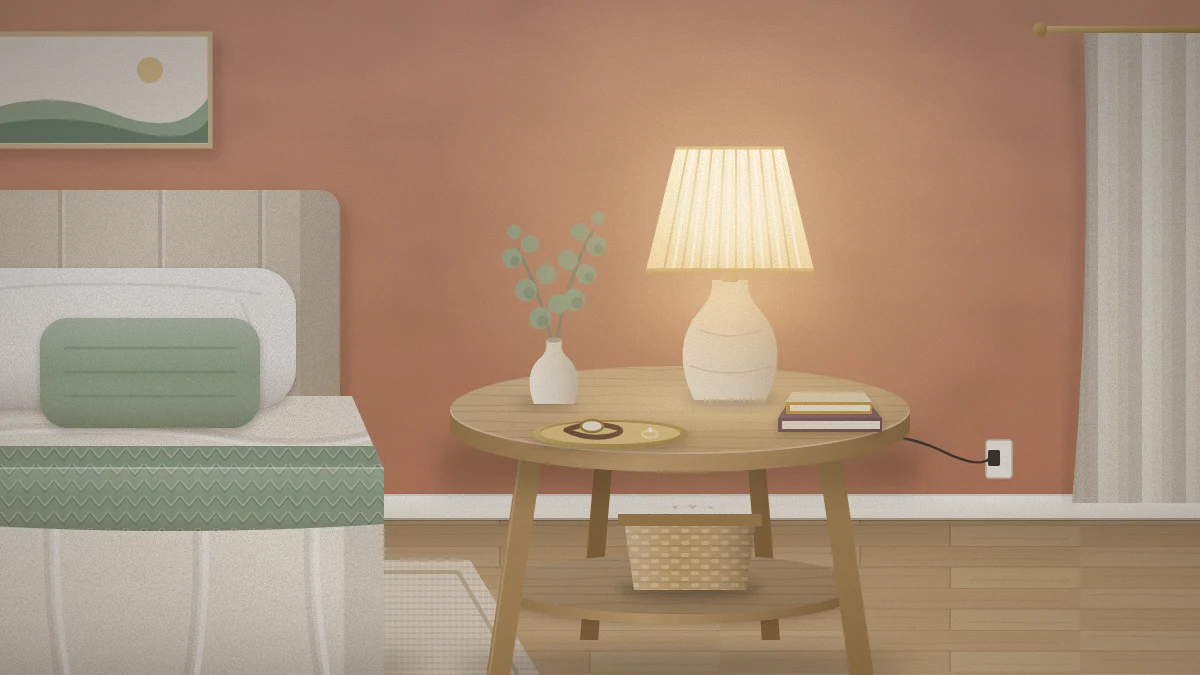
At a glance
What you need
- A slim table lamp or plug-in wall light
- A bud vase with two stems or a small plant
- A small tray or dish with a raised rim
- One or two books
- A soft cloth
Good bedside table styling is mostly subtraction. A nightstand in a small bedroom is often only 14 to 18 in (35 to 45 cm) across, about the size of a dinner placemat, and it sits right at eye level when you lie down. Six ordinary objects are enough to make it look chaotic.
The fix is a four-part formula with a fixed limit on how much of the top you cover. It takes a few minutes, uses what you already have, and survives daily life because the everyday items get a set home.
The four-part formula
Every piece on the table should fill one of four roles. If something does not fit a role, it lives elsewhere.
| Role | What to use | Why it works on a small top |
|---|---|---|
| Light source | A slim table lamp, or a wall light beside the bed | Gives the arrangement its tallest point and a warm glow at night |
| Tall organic element | A bud vase with two stems, or a small plant | Adds a soft, irregular shape among hard edges |
| Low tray or dish | A 4 to 6 in (10 to 15 cm) dish in brass, wood or ceramic | Turns loose daily items into one tidy object |
| Books | One or two, lying flat | Adds a horizontal layer and a low platform |
What you need
- A lamp with a base no wider than about a third of the tabletop
- A small vase or a plant in a pot roughly 3 to 4 in (8 to 10 cm) across
- A small tray or dish with a raised rim
- One or two books you are reading or like the look of
- A cloth to wipe the surface
Style the nightstand step by step
- Empty the top. Take everything off, including the lamp, and wipe the surface. Starting from bare wood is the only way to see how little you need.
- Set the lamp at the back, on the side away from the bed. The back corner farthest from your pillow keeps the shade clear of the bedding and leaves the near edge free for your hand. Check the height: the bottom of the shade should sit close to chin level when you are propped up reading, so the bulb is not in your eyes.
- Lay the books flat. Place one or two toward the front or beside the lamp, spines facing out. They create a second level a couple of inches high.
- Add the tall organic element. Stand the bud vase on the books or just behind them. It should reach about half to two thirds of the lamp’s height, so the eye steps down from lamp to stems to books instead of meeting two equal peaks.
- Place the dish at the front, nearest the bed. This is where a watch, rings, lip balm or earplugs go. Because the dish has an edge, three or four small things look contained.
- Check the empty third. Look straight down at the table. Roughly a third of the surface should still be visible, ideally as one open patch at the front. That patch is where a glass of water lands at night.
Tip
Match the shape of the dish to the table for calm, or contrast it for interest: a round dish softens a square nightstand, and a small rectangular tray gives a round table one straight line.
How to judge the result
Sit on the bed and look across at the table, since that is the angle you see most.
- Three heights. You should be able to name a tall, a middle and a low item. If two are the same height, swap one.
- Nothing overhangs. Every object sits fully inside the edge, with a finger-width margin. Overhang makes a small table look overloaded.
- No more than three materials. For example ceramic lamp, brass dish, wood table. The books and stems count as accents.
- The one-hand test. You can switch off the lamp and put down a glass without moving anything.
Free the surface with a wall light
On a table under about 14 in (35 cm) wide, a lamp base can take a third of the top by itself. Moving the light to the wall hands that space back. A plug-in wall light with a swing arm, placed so the shade sits a little above shoulder height when you are sitting up in bed, does the lamp’s job from above.
Choose a plug-in or rechargeable model and fit it with hardware rated for it and suited to your wall type, following the manufacturer instructions. Keep any shade or bulb clear of curtains and pillows. A hardwired wall light is a job for a licensed electrician. For placement and bulb warmth across the room, see these lighting ideas for a small bedroom.
When there is no room for a table
If the gap beside the bed is under about 12 in (30 cm), a standard nightstand will not fit, but the formula still does on a smaller scale.
- A stool. A round wooden stool around 12 in (30 cm) across holds a book, a dish and a bud vase. Its open legs show the floor, which keeps the corner light. Pair it with a wall light.
- A small wall shelf. A shelf about 12 x 6 in (30 x 15 cm) set level with the mattress top takes a dish and a small vase and leaves the floor clear. Use fixings rated for the shelf and keep its contents within what the maker states.
- Stacked trunks. Two small trunks, larger one below, reach bedside height and add texture. They are one of several storage pieces that work as decor.
Match the two sides, or mismatch on purpose
A matched pair of tables with identical lamps gives a small room symmetry, which reads as order. It suits a bed centered on its wall.
If the two sides differ in width, or the bed is pushed toward one wall, mismatch deliberately. Keep one element constant, usually the lamp or the height of the surface, and vary the rest: a round table on one side, a stool on the other, the same lamp style on both. One repeated element is what separates an intentional mismatch from an accident.
Keep it looking styled
Once a week, replace tired stems and move on anything that has drifted onto the table. If the dish is overflowing, it is too big a job for a dish; a larger tray on the dresser is the better home, and the same layered approach applies when you style a dresser top.
Frequently asked questions
How many things should be on a small nightstand?
Four groups is a reliable ceiling: a light, one taller natural element such as a vase or plant, a dish that gathers small daily items, and a book or two. Anything beyond that usually pushes coverage past two thirds of the top, which is where a compact surface starts to look crowded.
How tall should a lamp be on a bedside table?
A helpful check is to sit up in bed as you would to read. The lower edge of the shade should be near chin level, so light falls on the page and the bulb stays out of view. On a low table that often means a taller, slimmer lamp than you might expect.
Do both nightstands have to match?
No. A matching pair gives symmetry, which suits a bed centered on the wall. If space differs on each side, use different pieces and repeat one thing, such as the same lamp or the same surface height. That single shared element makes the difference look chosen instead of accidental.


