Small Bedroom Lighting Ideas: Layered Light Without the Clutter
Replace one harsh ceiling light with soft layers. Six plug-in and battery fixtures that take almost no space, plus how to choose warm white bulbs, diffusing shades and lamps that double as decor.
One ceiling light in the middle of a small bedroom does two unhelpful things. It lights the floor and the top of the bed brightly while leaving the corners dim, which pulls the walls inward, and it flattens every texture you chose with care. The room looks smaller and plainer at night than it does by day.
The small bedroom lighting ideas here replace that single source with several low, soft ones. None of them needs a table you do not have or any change to the building: every option is a plug-in, battery or rechargeable light.
Think in three layers
- Ambient light is the general glow that lets you move around. In a small room it should come from the sides and bounce off walls, not glare down from one point.
- Task light is aimed at one job: reading in bed, choosing clothes, seeing your face in a mirror.
- Accent light is there only to look good. It grazes a wall, glows behind a headboard or picks out a picture.
Three or four sources spread across those layers are enough for a room of about 10 x 10 ft (3 x 3 m). Set them at different heights, and light at least two corners; lit corners are what make the walls seem farther apart.
Six fixtures that take almost no space
| Fixture | Layer | Where it goes |
|---|---|---|
| Plug-in wall lights | Ambient and task | Each side of the bed |
| Slim table lamp | Ambient | Dresser or nightstand |
| Clip or swing-arm reading light | Task | Headboard or beside the pillow |
| Small floor lamp | Ambient | The darkest corner |
| LED strip | Accent | Behind the headboard |
| Battery picture light | Accent | Above art or a shelf |
Plug-in wall lights
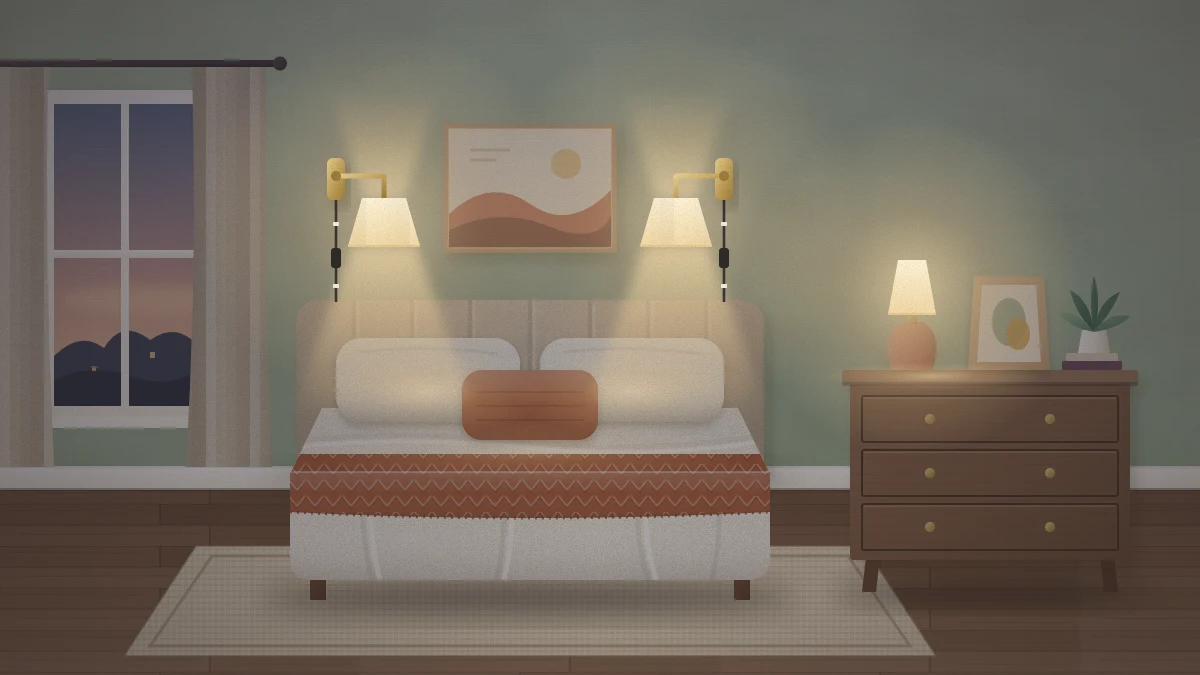
A plug-in wall light, a sconce with a cord and plug instead of in-wall connections, clears the whole nightstand. Place each one about 6 to 8 in (15 to 20 cm) out from the edge of the headboard, with the shade roughly at shoulder height when you sit up in bed. Let the cord drop straight down the wall inside a slim cord cover so it reads as a deliberate line.
A slim table lamp
Choose a base no wider than about 5 in (13 cm) and a shade around 9 to 10 in (23 to 25 cm) across, so the lamp leaves room for a book and a glass. One on the dresser, opposite the bed, lights the far side of the room and gives you something warm to look toward. For how to fit a lamp among the other things beside the bed, see the guide to bedside table styling.
A clip or swing-arm reading light
A small clip light on the headboard, or a swing-arm lamp you can pull over the page and push flat again, puts a narrow beam exactly where you read. Because the beam is tight, a partner can sleep and the rest of the room can stay dim.
A small floor lamp in a corner
A floor lamp with a base about 10 in (25 cm) across fits into a corner that is no use for furniture. Pick one that sends light up and out through a fabric shade; washing the corner and ceiling with light is one of the simplest ways to push the walls back visually. More techniques like it are in the guide on how to make a small bedroom look bigger.
An LED strip behind the headboard
A plug-in LED strip on the back of the headboard, facing the wall, creates a soft halo that makes the bed seem to float slightly forward. Use it as its instructions say, and keep the strip and its power supply clear of pillows and bedding. A warm white strip looks restful; changing colors rarely do.
Battery picture lights
A rechargeable or battery picture light above a print adds a pool of light with no cord at all, and it turns one piece of art into an evening focal point.
Bulbs: warm white, and all the same
Choose warm white bulbs, around 2700 K, for every lamp in the room. Higher figures look cooler and bluer, closer to an office. Warm, low light is also the base that the other cozy small bedroom ideas build on.
Matching matters as much as warmth. One cool bulb among warm ones makes a small room look patchy, because you can see every source at once. Buy the same type of bulb for all the lamps, and check that each bulb suits its lamp as the lamp’s label states.
Tip
Lamps with a built-in dimmer or bulbs with several brightness steps let one lamp serve as both reading light and night glow, so you need fewer fixtures.
Shades that diffuse
A bare bulb at eye level is harsh from a pillow. Look for shades in linen, cotton, paper or frosted glass that hide the bulb from where you lie and spread its light. Pale shades glow and add to the ambient layer. Dark or metal shades throw light only up and down, which suits a reading light and little else.
Lamps as decor objects
A lamp is on display all day, switched on or not. Treat the base as a piece of decor: ribbed ceramic, turned wood, aged brass or colored glass that repeats a finish already in the room, such as the curtain rod or a mirror frame.
Keep the lamp family small. Two finishes across all the lights look collected; four look accidental.
Cords, heat and placement
Plan where each cord runs before you settle on a spot. Run cords along the baseboard or straight down the wall in a cover, never under a rug, bedding or the mattress, and plug each lamp in directly where you can. A plug-in wall light is fixed to the wall, so follow the manufacturer instructions and use fixings suited to your wall type.
Safety note
Keep lamps and bulbs clear of curtains, canopies and bedding, and use every LED product as its instructions say. If you like the look of a flame, choose flameless LED candles. Anything that needs new wiring, including a ceiling fixture or a wall light without a plug, is a job for a licensed electrician.
A simple plan for one evening
Start with a reading light at the bed and one lamp across the room. Switch off the ceiling light and look from the door. Add a third source wherever it is still dark, usually a corner. If you can read comfortably and see no bare bulb from the pillow, the layers are doing their work.
Frequently asked questions
How many lights does a small bedroom need?
Three or four sources are usually enough: a reading light at the bed, a lamp on the far side of the room, something to brighten a dark corner and an optional accent. Spreading them at different heights matters more than the total number, because it removes the dim corners that make a room feel tight.
What color temperature is best for a bedroom?
Warm white, around 2700 K, is the usual choice because it gives a soft, yellowish light that many people find restful in the evening. Whatever you choose, use the same color temperature in every lamp so the room looks even instead of patchy.
Can I add wall lights without changing the electrics?
Yes. Plug-in wall lights have a cord and plug, and battery or rechargeable wall lights need no cord at all. Fix them as the manufacturer instructions describe and keep cords tidy in a cover. A wall light that connects inside the wall is a different job and belongs to a licensed electrician.