Small Bedroom Decorating Mistakes: 10 Things That Shrink a Room
Ten common decorating missteps that make a small bedroom look tighter and busier than it is, each with the reason it happens and a practical fix, plus a quick check you can do from the doorway.
If your bedroom feels cramped even when it is tidy, the square footage is probably not the whole story. A few habits make a compact room read smaller than it is, and most are easy to spot once you know where to look.
These ten small bedroom decorating mistakes are grouped by cause. Each comes with the reason it shrinks the room and a fix, and most fixes mean moving or removing something, not buying.
Mistakes of scale
1. Furniture that is too big, or too many pieces
A queen bed, two nightstands, a deep dresser, a chair and a bench in a room of 10 x 10 ft (3 x 3 m) leave only strips of floor, and visible floor is how the eye measures a room. Keep the pieces you use daily and question the others. One nightstand in place of two, or a dresser about 16 in (40 cm) deep in place of a 20 in (50 cm) one, gives back a surprising amount. The guide to small bedroom furniture placement helps you decide what stays.
2. A rug that is too small
A mat of 2 x 3 ft (60 x 90 cm) beside the bed looks like a bath mat and turns the floor around it into leftover space. One rug that runs under the bed and shows on both sides joins the floor into a single surface. Sizes are in these small bedroom rug ideas.
3. Art that is too small or hung too high
A single 8 x 10 in (20 x 25 cm) frame over a queen bed looks lost, and art hung near the ceiling floats free of the furniture below, so the wall breaks into unrelated parts. Choose one piece or a tight group about two thirds the width of the bed, with its lower edge roughly 6 to 10 in (15 to 25 cm) above the headboard. Options are compared in the guide to wall decor above the bed.
Safety note
Anything above the bed should be lightweight and securely fixed, with hardware rated for the piece and suited to your wall type. Follow the manufacturer instructions, and avoid heavy mirrors and glass-fronted frames directly over the pillows.
A mistake of height
4. Curtains hung at window height
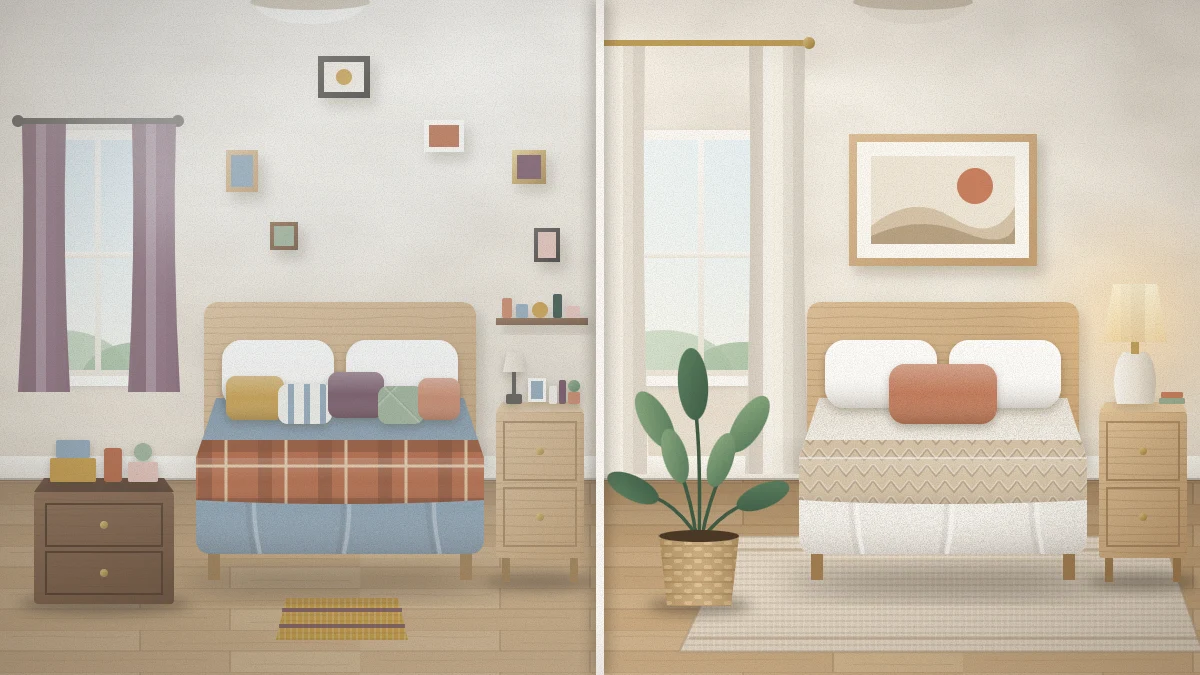
A rod fixed on the window frame, with curtains that stop at the sill, cuts the wall into short horizontal bands and makes the ceiling feel lower. Raise the rod to within about 4 to 6 in (10 to 15 cm) of the ceiling and use panels that reach the floor. The long vertical line makes both the window and the wall look taller.
A mistake of light
5. One harsh overhead light
A lone ceiling light throws flat, bright light on the middle of the room and leaves the corners dim. Dim corners make the walls feel closer, and hard shadows show every bit of clutter. Add two plug-in lamps at different heights, with fabric shades and warm white bulbs, and leave the ceiling light off in the evening. Keep lamps clear of curtains and bedding. More compact options are in these small bedroom lighting ideas.
Mistakes of too much
6. Too many small accessories
Each object has an outline, and a dresser with fifteen outlines reads as mess even when it is clean. Clear the surface, then put back three to five things at most, with at least one of some size: a lamp, a vase with branches, a tray that holds the small items together. Leave about a third of the top empty.
7. Too many competing colors and patterns
Every extra color adds edges where it meets its neighbors, and edges are what make a room look busy. Count the colors you can see from the door. If there are more than three besides white and wood, remove the weakest. Keep to one larger pattern and one small one in the same colors, and let everything else be plain or textured.
8. Every wall decorated
When all four walls carry frames, shelves or hooks, nothing is the focal point and the eye never rests. Decorate the headboard wall properly, give one other wall a single job, such as a mirror, and leave at least one wall bare. That empty wall is negative space, and it makes the decorated one look better.
Mistakes of arrangement
9. Furniture that blocks the sightline
A tall dresser just inside the door, or a chair in the path to the window, stops your view within the first few feet, and that first glance sets your impression of size. Move tall and bulky pieces to the wall beside or behind the door, keep them secured against tipping, and leave an open route about 24 to 30 in (60 to 75 cm) wide toward the window. Do not block a vent or radiator to get it.
10. Matching everything so nothing stands out
A bedroom set in one finish, with bedding and curtains from one matching collection, is tidy but flat. With nothing to contrast, the bed does not stand out as the focal point, and the furniture merges into one heavy mass. Break the set in one or two places: a fabric headboard against wood nightstands, a painted nightstand beside an oak dresser, or a throw in a rougher texture than the duvet cover.
Which mistake to fix first
Start with whatever costs nothing. Mistakes 6, 8 and 9 are fixed by taking things away or moving them, and you can do all three in an afternoon. Rehanging curtains and art comes next, since you already own the pieces. The rug, the lamps and any furniture swap can wait until you have seen how much the free changes achieve.
A five-minute check from the doorway
- Stand in the doorway and look for the first thing that stops your eye. If it is not the bed, something is in the way.
- Count the colors and the patterns you can see.
- Look at the curtain rod. Is there a wide band of bare wall above it?
- Look at the floor. Can you see it on both sides of the bed, and is the rug joined to the bed or stranded?
- Squint. Any area that turns into a speckled blur has too many small things in it.
Fix one mistake at a time and look again from the same spot. The change is usually obvious, and often two fixes are enough.
Frequently asked questions
Why does my small bedroom look cluttered even when it is clean?
Usually because there are too many separate things to look at: many small accessories, several colors and patterns, and decor on every wall. Each one adds outlines. Reducing surfaces to a few larger pieces and leaving one wall bare calms the room without removing anything you need.
What is the most common decorating mistake in a small bedroom?
Scale is the most frequent problem, and it goes both ways. Furniture is often too large or too plentiful for the floor, while rugs and art are too small for the bed they sit beside. Matching the rug and the art to the width of the bed corrects much of it.
Should everything in a small bedroom match?
No. A fully matched set looks flat because nothing stands out as the focal point. Keep a consistent palette, then vary one or two things, such as a fabric headboard with wood nightstands or a rough-textured throw on smooth bedding, so the room has some contrast.