How to Style a Dresser Top in a Small Bedroom
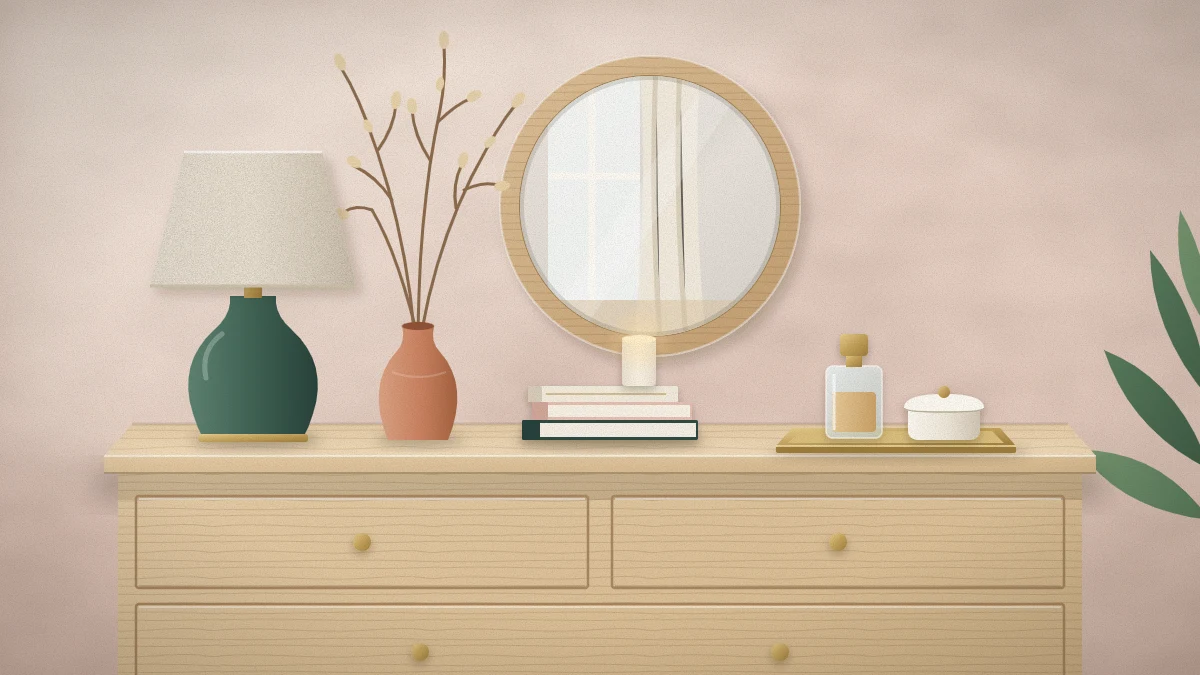
Build a dresser top in four layers: an anchor on the wall, a tall element on one side, a low tray grouping on the other and a stack of books between them, with working space left free.
At a glance
What you need
- A mirror or framed art about half to two thirds the dresser width
- A table lamp or a vase with tall branches
- A low tray
- A small lidded box and one or two small objects
- Three or four books with quiet covers
- A flameless LED candle
The dresser is usually the largest flat surface in a small bedroom after the bed, which is exactly why it fills up. Keys, receipts, a hairbrush and yesterday’s jewelry land there because nothing else on it says “this space is taken.”
When you style a dresser top in layers, each part of the surface gets a clear purpose, and an arrangement with a clear purpose is much harder to pile things onto. The method below builds from the wall forward in four layers and leaves you a working area at the end.
Gather your pieces
A typical small-bedroom dresser is 30 to 48 in (75 to 120 cm) wide and about 18 in (45 cm) deep. For that size you need surprisingly little:
- One anchor: a mirror or a framed piece of art
- One tall element: a table lamp, or a vase with branches
- A low tray, about 8 x 12 in (20 x 30 cm)
- Two or three small items for the tray: a lidded box, a perfume bottle, a flameless LED candle
- Three or four books with quiet covers
Pick pieces that repeat a finish already in the room. If the bedside lamp has a brass base, a brass tray on the dresser links the two sides of the room, and a small space looks more settled when its materials echo each other.
Build the four layers
- Clear and wipe the top. Remove everything. You are composing on an empty surface, not editing a crowded one.
- Layer one: the anchor. Hang or lean a mirror or artwork behind the dresser. Aim for a width between half and two thirds of the dresser’s width, so on a 36 in (90 cm) dresser, a piece 20 to 24 in (50 to 60 cm) across. Smaller looks lost; wider than the dresser looks top-heavy. If it hangs, leave a gap of only 4 to 8 in (10 to 20 cm) above the top so the two read as one unit.
- Layer two: the tall element on one side. Place the lamp or the vase of branches at one end, about a hand’s width in from the edge. Its top should reach somewhere between halfway and three quarters up the anchor. This creates the high point of the composition.
- Layer three: the low grouping on the other side. Set the tray at the opposite end and put three things on it in stepped heights: the bottle, the small box and the flameless LED candle. Odd numbers avoid the paired-off, formal look that even numbers produce.
- Layer four: the bridge. Lay a stack of three books flat between the tall side and the tray, nearer the tall side. It fills the height gap between high and low so the eye travels down a slope instead of dropping off a cliff.
- Clear the working space. Make sure a stretch about 10 to 12 in (25 to 30 cm) wide remains empty at the front. This is where you set down a mug or a folded sweater.
Safety note
Hang a mirror or frame with hardware rated for the piece and suited to your wall type, and follow the manufacturer instructions. A leaning mirror should be secured at the top so it cannot slide or tip, and a dresser itself should be fixed to the wall with its anti-tip kit.
Why asymmetry suits a small dresser
A symmetrical setup, with a matching lamp at each end and a mirror dead center, needs width to breathe. On a dresser under about 48 in (120 cm) it uses the whole surface and leaves nowhere to put anything down.
Asymmetric balance uses less. One tall, slim element on the left is balanced by several low, spread-out items on the right, the way a tall adult and two children balance on a seesaw. The visual weight is equal, but the shapes differ, and the surface between them stays open.
Mirror or art as the anchor?
Choose a mirror if the dresser faces or sits beside a window, because it will bounce daylight back into the room and double as a dressing mirror. A round mirror is especially useful above a boxy dresser since it is the one curve among straight lines. The guide to using mirrors in a small bedroom covers what a mirror should and should not reflect.
Choose art if the dresser faces the bed and a mirror would only reflect rumpled covers, or if the room needs color. A leaning frame can be layered with a smaller one overlapping in front of it, which adds depth without another fixing in the wall.
How to tell it is working
- The triangle test. Trace a line from the top of the tall element to the top of the anchor to the tray. It should form a lopsided triangle, not a flat row.
- The squint test. With eyes half closed, both ends should feel equally heavy. If the tray side looks thin, add a taller object to it or slide the books toward it.
- The palette count. Two materials plus one accent color is plenty.
- The drop test. Put your phone and keys down without moving anything. If you cannot, remove one object.
Tip
If small things keep landing on the dresser, give them a lidded box on the tray. A lid hides the contents, so the arrangement looks the same on a busy day as on a tidy one.
Variation for a narrow tall chest
A tall chest about 24 to 30 in (60 to 75 cm) wide and chest height changes the rules, because you see its top from below or straight on, and there is room for only one layer.
- Skip the tray-and-bridge sequence. Use three items in total: one tall, one medium, one low.
- Choose things with a strong outline, such as a vase of branches, a small framed print leaning on the wall and a lidded box, since flat items disappear at that height.
- Hang art slightly smaller than the chest width and keep the gap tight.
- Keep the lamp for a lower surface; a shade above eye level shows you the bulb.
Connect it to the other surfaces
The dresser should not be the only styled surface, or it will look staged. Use the same finishes in a smaller, simpler version beside the bed, following the formula for styling a small bedside table. If you have a shelf on the same wall, repeat one material there too; the approach for styling bedroom shelves uses the same anchors and groups of three.
Frequently asked questions
How big should a mirror above a dresser be?
A width between half and two thirds of the dresser is a dependable range. On a 36-inch dresser that means a mirror about 20 to 24 inches across. Keep the gap between the dresser top and the bottom of the mirror small, roughly 4 to 8 inches, so the two look like one composition.
Should a dresser top be symmetrical?
It can be, but symmetry uses the full width, which is hard on a small dresser. An asymmetric layout with one tall element on one side and a low group on the other balances just as well visually and leaves an open stretch of surface for things you set down during the day.
How do I stop the dresser top from collecting clutter?
Give small everyday items one defined spot, such as a tray with a lidded box, and keep the rest of the arrangement deliberate. When every part of the surface has an obvious role, stray objects look out of place and are easier to notice and move.