Mirrors in a Small Bedroom: Where to Place Them as Decor
Where a mirror goes matters more than how big it is. Five placements that brighten and open up a small bedroom, the spots to avoid, and how to choose a frame finish that works as decor.
Before buying a mirror, stand with your back against the wall where you plan to put it and look straight ahead. Whatever you see from there is what the mirror will show the room, twice over. If the view is the window, you gain light. If it is the open closet or a chair piled with clothes, you gain a second pile.
That one test explains why mirrors in a small bedroom sometimes open the room up and sometimes just make it busier. Size matters less than what is reflected, so the placements below start with the view and work back to the mirror.
Choose the reflection first
A mirror is a borrowed view. Three things are worth borrowing in a bedroom:
- The window. Reflected daylight brightens the side of the room the window cannot reach.
- A calm surface. A plain wall, drawn curtains or a neatly made bed reflect as quiet color and add depth without detail.
- A long sightline. A mirror that catches the view through the doorway or along the longest wall stretches the room in that direction.
Avoid aiming a mirror at open shelving, a desk, a laundry basket or the television. Each of those is visual noise, and a mirror doubles it.
Tip
Tape a sheet of kraft paper the size of the mirror to the wall and leave it for a day. Then hold a hand mirror flat against it at eye level to preview the reflection before you commit.
Five placements that work as decor
A tall floor mirror leaning in a corner
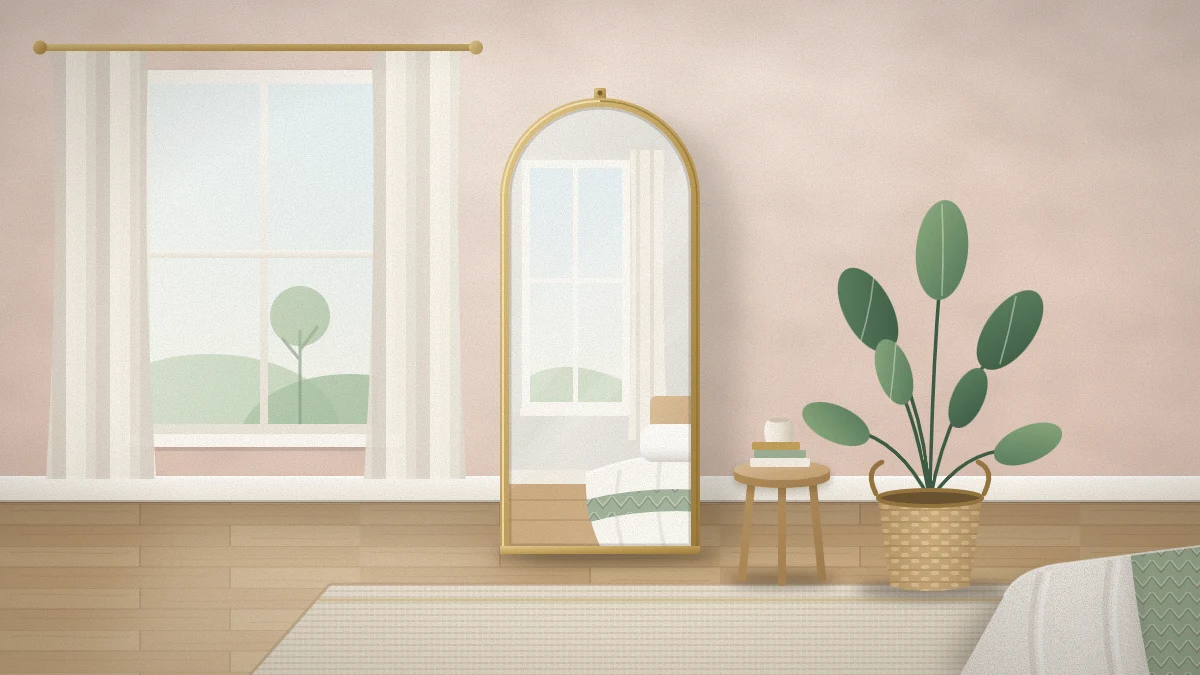
A full-length mirror about 65 x 22 in (165 x 56 cm), leaning in the corner beside the window, reflects light across the room and reads as a narrow doorway into more space. Its height also draws the eye up, which helps under a low ceiling. Give it a base: a plant in a basket or a small stool beside it makes the corner look arranged.
A round mirror over the dresser
A round mirror roughly two thirds the width of the dresser, about 28 in (71 cm) over a 42 in (107 cm) piece, softens the hard lines of drawers and closet doors. Hang it so the bottom edge sits around 6 to 8 in (15 to 20 cm) above the top, close enough to pair with a lamp and a tray beneath. The guide to styling a dresser top shows how to arrange that surface so the reflection stays tidy.
A mirror beside the window
On the wall at a right angle to the window, a mirror catches daylight at a slant and throws it deeper into the room. It also reflects the curtains, which repeats their soft folds. This is often the brightest position available, and it avoids the glare of a mirror directly facing the glass.
A pair of narrow mirrors
Two slim mirrors, each about 12 x 48 in (30 x 122 cm), hung one on each side of the bed above the nightstands or side by side on a blank wall, act like extra windows. A pair fits where one wide mirror cannot, and the repetition adds symmetry to a room that may have little of it.
Mirrored closet doors
If the closet has sliding doors, mirrored panels turn the largest flat surface in the room into reflection and need no wall or floor space. They work best when they face the window or a plain wall. If they face the bed and you find that distracting, sheer curtains on a rod above the doors can soften them at night.
Where a mirror works against you
- Facing clutter. Move the mirror, or change the view.
- Directly opposite the window, at the same height. It can bounce harsh glare at certain hours. Shifting it a foot or two (30 to 60 cm) to one side keeps the light and loses the dazzle.
- Above the bed. A heavy mirror does not belong over the pillows. Anything above the headboard should be lightweight and securely fixed, and a mirror is better placed on another wall.
- Several unrelated mirrors. Reflections facing each other across a small room multiply every object. One main mirror, or one matched pair, is enough.
Size and height
Choose the largest mirror the spot can take without crowding. A big mirror with a thin frame reflects a broad, readable piece of the room; a small one reflects a fragment and looks like one more object on the wall.
For a wall mirror you stand in front of, center it at roughly eye level, about 57 to 60 in (145 to 152 cm) from the floor. For one above furniture, keep the gap small so the two pieces read together. Mirrors are one of several ways to stretch a room visually; the others are gathered in the guide on how to make a small bedroom look bigger.
Frame finishes as decor
The frame decides whether the mirror blends in or stands out.
- Thin brass or gold metal adds a warm line and suits white, cream and warm gray walls.
- Thin black metal gives a crisp outline; repeat black somewhere else, such as a lamp base, so it does not look isolated.
- Natural wood or rattan brings texture and pairs well with linen bedding and woven baskets.
- Frameless or painted to match the wall nearly disappears, leaving only the reflection. Choose this when the room already has enough going on.
An arched top is a good compromise between round and rectangular: it softens the room and still gives a full-length view. Match the finish to one already in the room, and see the other small bedroom wall decor ideas if you want a mirror to share a wall with art.
Keeping mirrors secure
A leaning mirror looks casual, but it should never be left free to slide or fall. Secure it against tipping with the anti-tip fixing supplied or recommended by its maker, set the foot on a level, non-slip surface, and keep it out of the swing of doors and the path beside the bed.
Safety note
Hang wall mirrors with hardware rated for the mirror and suited to your wall type, and follow the manufacturer instructions. Check the weight rating on the package instead of guessing. If you are unsure what is behind the wall, such as pipes or cables, ask a professional.
Frequently asked questions
Where is the best place for a mirror in a small bedroom?
The wall beside the window, at a right angle to it, is usually the strongest position because the mirror catches daylight and sends it deeper into the room. Above the dresser is a close second. In every case, check what the mirror will reflect before choosing the spot.
Should a mirror face the window?
It can, but a mirror directly opposite a window at the same height sometimes throws harsh glare at certain times of day. Placing it on the adjacent wall, or shifting it a little to one side, usually keeps the extra brightness while avoiding the dazzle.
Do leaning floor mirrors need to be fixed to the wall?
Yes. A leaning mirror should be secured against tipping, using the anti-tip fixing its maker supplies or recommends, and it should stand on a level, non-slip surface away from door swings. This matters even more in homes with children or pets, where a mirror may get pulled or bumped.