Small Bedroom Wall Decor Ideas: 9 Ways to Dress a Wall
Nine wall decor concepts sized for a small bedroom, from one oversized print to a painted arch, with scale rules of thumb and the reason each idea works when wall space is short.
A small bedroom has less wall than it seems. Subtract the window, the door, the closet and the stretch hidden behind the headboard, and you are usually left with two or three usable patches. That is why small bedroom wall decor works best when each patch gets one clear idea instead of a scattering of little things.
The nine concepts below are grouped by what they do for the room: anchor it, add texture, bounce light or bring in color without using any floor. Choose two or three of them, not all nine.
Three scale rules before you choose
- Fill about two thirds of the furniture below. Over a 48 in (122 cm) dresser, aim for art or a grouping about 32 in (81 cm) wide. Much narrower looks stranded; wider than the furniture looks top-heavy.
- Start at eye level, then adjust. A center point around 57 in (145 cm) from the floor suits a wall you stand in front of. Above furniture, keep the gap to roughly 6 to 10 in (15 to 25 cm) so the art and the piece below read as one unit.
- Go bigger and fewer. Every small item adds four more edges, and edges are what make a compact room feel busy. One 24 x 36 in (61 x 91 cm) print is calmer than six postcards.
Single pieces that anchor a wall
1. One oversized piece
A single large print or canvas gives the eye one place to land, which makes the wall read as wider than a patchwork would. Choose an image with plenty of pale background so it has presence without visual weight, and put it on the wall you see first from the door. If that wall is the one behind the bed, the sizing and safety points change, so read the guide to what to hang over the headboard first.
2. A textile or woven hanging
A woven piece about 20 to 30 in (50 to 76 cm) wide, in undyed cotton, wool or jute, softens a room full of hard rectangles: closet doors, a dresser, a window frame. It has no glass, so it never glares, which makes it a good choice for the wall opposite a window where a glazed frame would only show reflections.
3. A round mirror
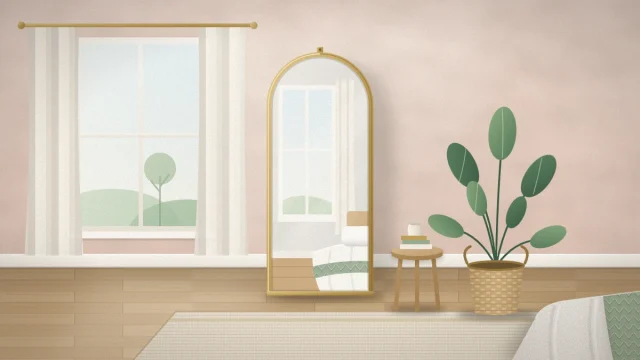
A round mirror roughly 24 to 30 in (61 to 76 cm) across breaks up all those straight lines and returns daylight to the darker side of the room. What it reflects matters more than its frame, and the guide to placing mirrors in a small bedroom covers the positions that work.
Groupings that read as one shape
4. A tight grid of frames
Four or six identical frames, about 11 x 14 in (28 x 36 cm) each and hung in a grid with gaps of around 2 in (5 cm), behave like one large piece. The clean rectangular outline is the point: it brings order to a wall that may already hold a door frame and a light switch. For mixed frame sizes, plan the layout on paper first with the gallery wall planning method.
5. Plates or baskets as a cluster
Five to seven shallow woven baskets or lightweight decorative plates, from about 6 to 14 in (15 to 36 cm) across and set close together, give you curves and texture in very little depth. Because they sit nearly flat, they suit the narrow strip of wall beside a door where a deep frame would get knocked. Keep to one material so the cluster reads as texture, not as a collection.
Shallow ledges that let you change your mind
6. A picture ledge
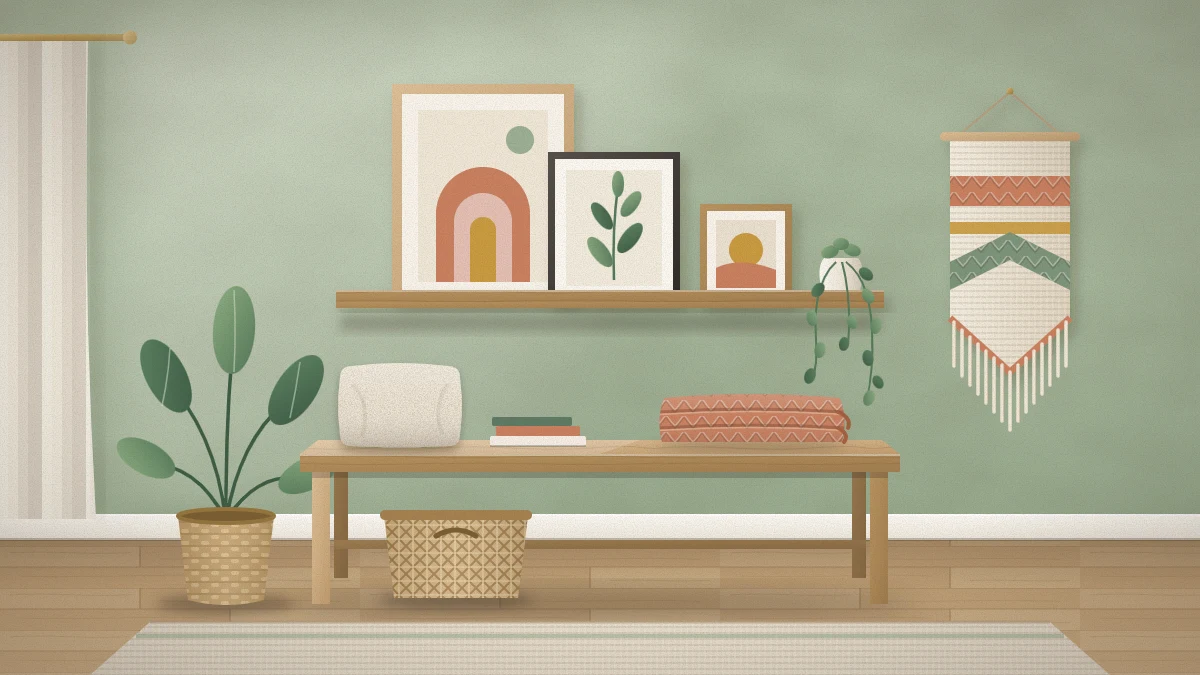
A ledge 3 to 4 in (8 to 10 cm) deep lets frames lean instead of hang, so you can swap art whenever you like with no new holes. Overlap three frames of different heights, tallest at the back, and stop there. Size the ledge to about two thirds of the bench, desk or dresser beneath it.
7. A slim shelf with leaning art
One step deeper, around 5 to 6 in (13 to 15 cm), gives room for a leaning frame, a small trailing plant and one ceramic piece. Leave a third of the shelf empty. That negative space is what makes it look styled instead of stored.
Safety note
Ledges and shelves are fixed to the wall, so use hardware rated for the piece and suited to your wall type, follow the manufacturer instructions, and keep what goes on the shelf within what its maker states. Anything placed above the bed should be lightweight and securely fixed. If you are unsure what is behind a wall, such as pipes or cables, ask a professional.
Decor with almost no depth
8. A pair of wall lights
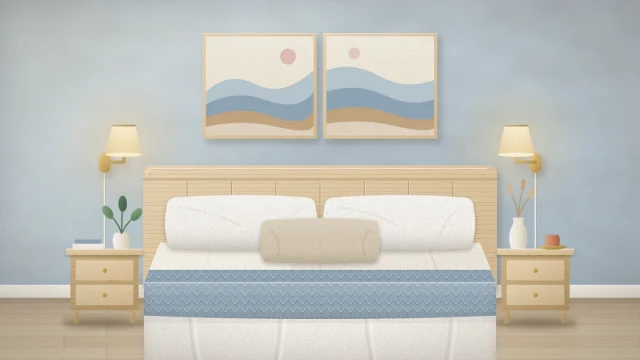
Two matching plug-in wall lights, one on each side of the bed or flanking a mirror, are decor by day and light by night. The symmetry does the work: a matched pair frames whatever sits between it and makes the arrangement look intended. Shades about 6 to 8 in (15 to 20 cm) wide in linen, brass or matte black are in scale with a full or queen bed, and they free the nightstand surface.
9. A painted shape
An arch, a circle or a wide horizontal band painted behind a dresser or desk makes a focal point with zero thickness, useful where a door swings close to the wall. Paint it a little wider than the furniture, in a muted tone two or three steps deeper than the wall color. If you rent, get permission before painting. For color on the whole wall, see the guide to a small bedroom accent wall.
Keep one wall quiet
Decor needs blank wall around it to be seen. In a room of about 10 x 10 ft (3 x 3 m), dress two walls at most and leave at least one completely bare, ideally the window wall or the one you face when lying in bed. A bare wall gives the eye somewhere to rest, and that makes the decorated walls look deliberate.
Match the frame finishes
Limit the room to two frame finishes, such as black with natural oak or brass with white, and use each at least twice so neither looks accidental. Take the cue from what is already there: the curtain rod, a lamp base, the drawer pulls. White or off-white mats in every frame tie different prints together and add pale space around each image, which keeps a small wall from feeling crowded.
Frequently asked questions
How much wall decor is too much in a small bedroom?
A useful limit is two decorated walls and one left completely bare. If you can see three separate arrangements from the doorway, the room will start to feel busy. Fewer, larger pieces with blank wall around them usually look calmer than many small ones spread across every surface.
Should wall art be large or small in a small room?
Larger is usually the better choice. One big piece creates a single focal point and fewer edges, so the wall reads as wider. Small items work when they are grouped tightly enough to form one shape, such as a grid of matching frames or a close cluster of baskets.
How high should art hang on a bedroom wall?
On an open wall, a center point of roughly 57 inches from the floor is a common rule of thumb. Above a dresser, bench or desk, ignore that number and keep the bottom of the art about 6 to 10 inches above the furniture so the two read as one arrangement.