How to Layer Bedding for a Cozy, Finished Bed
The layer order from the mattress up, with a duvet turned down by a third, a folded-back sheet, a coverlet and a throw, plus practical pillow counts for twin, full and queen beds.
At a glance
What you need
- Fitted sheet and flat sheet in crisp cotton
- Duvet with a cover, or a comforter
- A quilt or coverlet
- One throw
- Sleeping pillows
- One to three cushions or shams
A flat bed is nearly always a one-layer bed: a fitted sheet, a comforter pulled straight up to the pillows, done. It is tidy, but it has a single surface and a single height, so there is nothing for light to catch and nothing to suggest comfort.
Knowing how to layer bedding fixes that with five layers in a set order and a pillow count that stops well short of a mountain. In a small bedroom the bed is most of what you see, so this is the highest-impact styling job in the room, and it takes about ten minutes once you have the pieces.
What you need
- A fitted sheet and a flat sheet in crisp cotton
- A duvet with a cover, or a comforter
- A quilt or coverlet, ideally one size smaller than the bed or folded to suit
- One throw, about 50 x 60 in (127 x 152 cm)
- Sleeping pillows, plus shams or cushions as set out in the pillow table below
You do not need everything to match. You need everything to sit inside one palette: a light base, a middle tone and one deeper accent. If you are unsure which colors belong together, start with these bedding color combinations and come back.
The layer order, from the mattress up
- Fitted sheet. Pull it tight at all four corners. Wrinkles at this level show through as lumps in every layer above.
- Flat sheet. Lay it with the finished side facing down and the top hem level with the head of the mattress. Tuck the foot end and leave the sides loose for now.
- Duvet or comforter. Spread it over the flat sheet, right up to the head, and shake it from the foot end so the filling is even.
- Fold the duvet down by a third. Take the top edge of the duvet alone and fold it toward the foot so roughly the top third of the bed shows sheet. The fold creates a thick, soft ridge across the bed, which is where the look of depth comes from.
- Fold back the sheet. Turn the top of the flat sheet down toward the duvet in a cuff about 8 to 10 in (20 to 25 cm) deep. Because the sheet went on face down, the finished side now shows. Once the pillows are in place, this crisp band sits between them and the duvet ridge.
- Add the quilt or coverlet. Fold it in thirds lengthwise and lay it across the lower half of the bed, on top of the duvet, letting the ends hang evenly on each side. It should cover from about mid-bed to within 10 in (25 cm) of the foot.
- Drape the throw. Place it at the foot. For a neat look, fold it in thirds and lay it straight across. For a relaxed one, hold it by the center, let it fall, and set it diagonally over one foot corner.
- Place the pillows. Stand them against the headboard, largest at the back, following the formulas below.
Tip
For a fuller ridge, fold the duvet a little deeper, to just under half, and lift the fold once so it lofts instead of lying flat.
Pillow formulas that stay practical
Every decorative pillow has to go somewhere at night, usually the floor. These counts give a finished look with the fewest pieces to move.
| Bed | Back row | Front | Total |
|---|---|---|---|
| Twin | 1 sleeping pillow, upright | 1 square cushion, about 18 in (45 cm) | 2 |
| Full | 2 sleeping pillows, upright | 1 lumbar cushion, about 12 x 20 in (30 x 50 cm) | 3 |
| Queen | 2 sleeping pillows, upright | 2 square cushions, about 20 in (50 cm), or 2 shams and 1 lumbar | 4 or 5 |
Stand the sleeping pillows on their long edge against the headboard instead of laying them flat. Upright pillows add height at the head of the bed, which balances the folded layers at the foot.
Mix textures inside one palette
Layers in the same fabric blur into one. Layers in different textures stay distinct even when the colors are close, and that is what lets a quiet, pale bed look rich. Aim for four textures:
- Crisp cotton for the sheets, which gives the sharp folded band.
- Washed linen for the duvet cover, with its soft rumple and matte surface.
- A quilted layer for the coverlet, whose stitching adds a fine pattern of shadow.
- A knit for the throw, the chunkiest surface, kept to the smallest area.
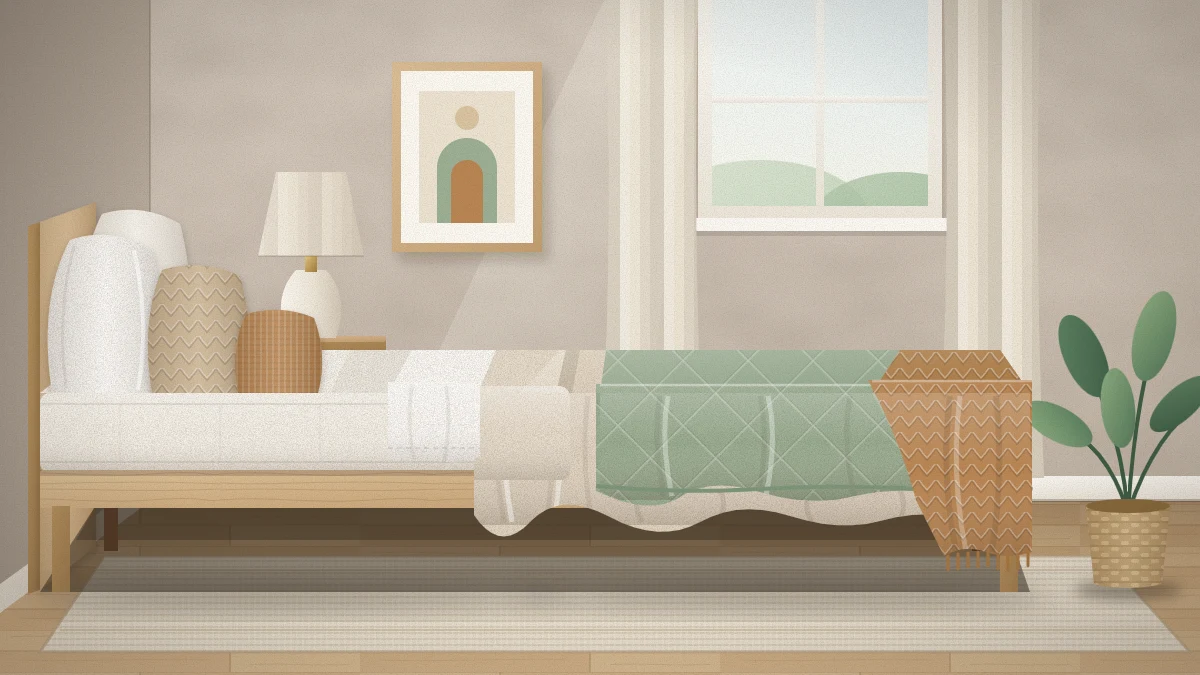
Order them from smooth at the head to rough at the foot, and from light to dark in the same direction: white sheet, oatmeal duvet, sage coverlet, caramel throw. A gradual shift keeps the bed looking long. A dark block in the middle would cut it in half, which makes both the bed and the room seem shorter.
How to judge the result
- From the door: you should count four horizontal bands (sheet, duvet, coverlet, throw) of clearly different depths.
- From the side: the profile should rise at the pillows, dip, rise slightly at the duvet fold and stay low at the foot.
- The overhang: layers should hang to roughly the same level on both sides and stop clear of the floor, so the bed does not look wider than it is.
- The palette: no more than three colors plus white.
If it looks fussy, remove the coverlet first. If it looks thin, deepen the duvet fold.
A pared-back version for a bed against the wall
A twin or full pushed into a corner is hard to make and is seen mostly from one side, so reduce the layers to three.
- Fitted sheet, then a duvet in its cover with no flat sheet, pulled up to the pillows.
- Fold the top of the duvet back once by about 12 in (30 cm) to show its underside or the sheet below.
- Lay one folded quilt or throw across the foot, with the excess hanging on the open side only.
Line two or three cushions along the wall side instead of at the head. This turns the bed into something closer to a daybed and gives you a backrest for sitting.
Adjust for season and warmth
The order stays the same year-round; only the materials change. In warm months, swap the duvet for a light cotton blanket. In cooler months, use a heavier quilt, a chunky knit throw and deeper tones, as in these fall bedroom decor ideas. Keep hanging edges away from heaters.
For the rug, lighting and curtains that complete a layered bed, see these cozy small bedroom ideas.
Frequently asked questions
What is the correct order to layer a bed?
From the mattress up: fitted sheet, flat sheet, duvet or comforter, then a quilt or coverlet over the lower half and a throw at the foot. Fold the duvet down by about a third, then turn the top of the flat sheet back in a deep cuff so each layer shows as its own band.
How many pillows should a layered bed have?
Fewer than most styled beds suggest. Two pillows in total suit a twin, three a full and four or five a queen, counting the pillows you sleep on. Standing the sleeping pillows upright at the back gives height, so one or two cushions in front are enough to finish the look.
Do I need a flat sheet to get the layered look?
No. A flat sheet gives the crisp folded band at the top, but you can skip it and fold the duvet back on itself to show the underside of the cover or the fitted sheet. A coverlet and a throw at the foot still provide the contrast in texture and depth.