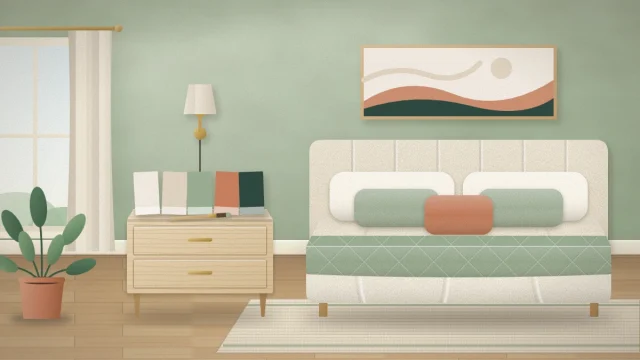
Bedding Color Combinations: 8 Pairings for a Small Bedroom
Eight two-color bedding pairings with a job for the sheets, duvet cover, pillows and throw, plus how to tie the bed to the wall color and keep pattern under control.

In a small bedroom the bed can cover a third of the floor, which makes the bedding the largest block of color in the room after the walls. Choose it well and the room looks finished before you hang anything. Choose it at random and no amount of art will pull things together.
The bedding color combinations below each use two colors, with white or a neutral allowed as a quiet third. Every pairing assigns a color to four parts: sheets, duvet cover, pillows and throw. Giving each part a role is what keeps two colors from turning into a patchwork.
How the roles work
Think of the bed in proportions. The duvet cover is the big field and sets the mood. The sheets show only as a folded band and at the pillows, so they are the place for the lightest tone. Shams and cushions repeat one of the two colors, and the throw is the accent: the smallest piece, and so the safest place for the strongest color.
In a small room, put the paler color on the duvet cover most of the time. A large pale surface reflects light back into the room, while the deeper color concentrated in a throw and two cushions gives contrast without adding bulk. The order the pieces go on the bed is covered in the guide on how to layer bedding.
Eight pairings and where each color goes
1. White and oatmeal
White sheets and duvet cover, oatmeal linen shams, an oatmeal knit throw. With so little contrast the bed reads as one soft shape, which makes it look smaller in the room. Texture has to do the work that color is not doing, so mix smooth cotton with nubby linen.
2. White and navy
White sheets and duvet cover, navy shams or one long navy cushion, a navy throw folded across the foot. The contrast is crisp, so keep navy to about a quarter of what you see. A navy duvet cover on a small bed turns the whole center of the room dark.
3. Sage and cream
Cream sheets, sage duvet cover, cream shams, a deeper green throw. Both are muted and close in value, so the pairing stays calm even with the color on the largest piece. It suits rooms with wood furniture, since green and warm wood sit comfortably together.
4. Blush and terracotta
White sheets, pale blush duvet cover, terracotta cushions, a terracotta or clay throw. These are a light and a deep version of the same warm family, which is why they never fight. Good in a north-facing room where cool daylight needs warming.
5. Gray and mustard
White sheets, light gray duvet cover, gray shams, and mustard on one cushion and the throw only. Mustard is strong; two small pieces are enough to lift gray from flat to deliberate. Choose a warm gray, because a blue-gray beside mustard can look harsh.
6. Blue and rust
White sheets, dusty blue duvet cover, white sleeping pillows, rust cushions and a rust throw. Blue and orange sit opposite each other on the color wheel, so each makes the other look richer; this is the idea behind complementary colors. Muted versions of both keep the energy suitable for a bedroom.
7. Tone-on-tone linen neutrals
Ivory sheets, a flax or sand duvet cover, shams one step darker, a throw one step darker again. Three or four neighboring tones of one color give depth with no contrast line cutting across the bed. This is the most forgiving choice when the walls are already a strong color.
8. Charcoal and white
White sheets with a deep fold-back, charcoal duvet cover, white shams, a pale gray throw. This is the one pairing here with the dark tone on the big field, so it needs a wide white band at the top and pale walls to keep the bed from reading as a dark slab.
The pairings at a glance
| Pairing | Duvet cover | Accent pieces | Effect in a small room |
|---|---|---|---|
| White and oatmeal | White | Oatmeal shams and throw | Quietest; bed recedes |
| White and navy | White | Navy shams and throw | Crisp and tailored |
| Sage and cream | Sage | Cream shams, green throw | Soft, good with wood |
| Blush and terracotta | Blush | Terracotta cushions and throw | Warms cool light |
| Gray and mustard | Light gray | Mustard cushion and throw | Neutral with one bright note |
| Blue and rust | Dusty blue | Rust cushions and throw | Liveliest contrast |
| Linen neutrals | Flax or sand | Darker shams and throw | Depth without contrast |
| Charcoal and white | Charcoal | White shams, pale throw | Graphic; needs pale walls |
Tie the bedding to the wall color
There are two reliable ways to connect bed and walls. The first is to match: a duvet cover within a shade or two of the wall lets the bed blend into the room, which makes the floor area seem larger. The second is to echo: keep the duvet cover neutral and repeat the wall color only in the cushions or throw.
What rarely works is a strong bed color unrelated to a strong wall color, because the two largest surfaces then compete. If you are still deciding on the walls, start with the palettes in small bedroom color ideas and choose bedding from the same three-part scheme.
Limit pattern to one scale mix
Pattern counts as visual weight. On a small bed, use one mix: a single larger pattern, such as a wide stripe or a big check about 3 in (8 cm) across, and one small pattern, such as a pinstripe or a tiny dot, both in the pairing’s two colors. Everything else stays solid.
Put the larger pattern on a smaller piece, a pair of shams or the throw, and keep the duvet cover plain or nearly so. Two patterns of the same scale blur together, and three or more make the bed the busiest thing in a room with little space to absorb it.
Let the throw carry the accent
The throw is the cheapest part to change and covers the least area, so it is where the bolder half of a pairing belongs. Fold it into a band about 18 in (45 cm) wide across the foot of the bed. A neat band reads as a deliberate stripe of color; a draped throw reads as texture.
Tip
Keep the sheets and duvet cover and swap only the throw and two cushion covers by season. Lighter accents for the warm months are covered in summer bedroom decor.
Frequently asked questions
What color bedding makes a small bedroom look bigger?
Pale bedding close to the wall color has the strongest effect, because the bed blends into the room instead of standing out as a separate block. White, cream, oatmeal and soft muted tones on the duvet cover all work, with a deeper color kept to the cushions and the throw.
How many colors should bedding have?
Two colors plus white or a neutral is a dependable limit for a small bed. One color takes the large surface, the other appears on two or three small pieces. A third strong color usually makes the bed look busy, since there is not enough area to repeat it convincingly.
Should bedding match the walls?
It can either match or echo them. A duvet cover near the wall tone makes the room feel calmer and more open. Alternatively, keep the main bedding neutral and bring the wall color back in a throw or cushions. Avoid a bold bed color that has no link to a bold wall.