Small Bedroom Color Ideas: Palettes That Open Up a Room
How color behaves in a compact bedroom, with six palettes described in plain words, notes on warm and cool whites, and a simple way to test a sample in your own light before you commit.

The usual advice for a small bedroom is to paint it white and stop there. White can work, but it is one answer among several, and a flat, cold white in a dim room often turns gray and looks smaller than a soft color would.
Useful small bedroom color ideas start with how color behaves in a tight space: how much light a surface bounces back, how sharply neighboring surfaces contrast, and whether the tones lean warm or cool. Get those three right and many different palettes will open up the room.
What color does in a compact room
Reflectance. Pale surfaces send more daylight on to the far corners, and a room with bright corners reads as larger. Many paint sample cards list a light reflectance value, a number from 0 to 100; the higher it is, the more light the color returns. Use it to compare two similar shades, not as a target.
Contrast. Where two very different tones meet, your eye sees a line, and those lines trace the outline of the room and show how close the walls are. Keeping the walls, trim, curtains and largest furniture near each other in tone softens that outline. In practice: paint the trim the wall color or one step lighter, hang curtains close to the wall shade, and choose a headboard and dresser in pale wood or a tone near the walls.
Color is only part of the picture. The guide on how to make a small bedroom look bigger covers curtains, mirrors and furniture.
Warm white or cool white
Whites are rarely neutral. Warm whites carry a little yellow or red; cool whites carry a little blue or gray. Hold a sample card against a sheet of plain printer paper and the undertone shows at once.
In a room with weak or bluish daylight, a cool white tends to look icy and flat, so a warm white is the safer choice. In a room with strong sun, a warm white can turn creamy yellow by afternoon, and a cooler white stays crisp. Whichever you pick, keep the whites in the room related. A cool white duvet cover against warm white walls makes one of them look dingy.
Build a three-part palette
- Main color: the walls and the largest textiles, around two thirds of what you see.
- Secondary color: most of the bedding, the curtains or the rug. It should sit close to the main color, a step darker or lighter.
- Accent: a small share, repeated in two or three places, such as one cushion, a throw and a vase. Repetition is what makes an accent look planned instead of stray.
Three parts are enough for a small room, because every extra color adds another set of edges. The bed is the largest block of color after the walls, so settle it early with these bedding color combinations.
Six palettes that suit a small bedroom
- Warm white and oatmeal. Warm white walls and trim, oatmeal linen bedding, pale oak and woven accents. It has the lowest contrast of the six and forgives dim rooms. Add texture, such as a nubby throw or a flat-woven rug, or it can look bland.
- Soft sage and cream. Grayed sage walls, cream trim and bedding, one clay accent. A muted green behaves almost like a neutral, and cream trim is only slightly lighter, so the edges stay soft.
- Pale blue-gray and white. Cool colors seem to recede, so the walls feel a little farther away. It suits sunny rooms best. Add natural wood or a rust accent to keep it from feeling chilly.
- Blush and clay. Dusty plaster-pink walls, cream bedding, clay or terracotta in small touches. It warms a room with cool daylight. Choose a blush with some gray or brown in it; a clear pink reads sweeter and louder.
- Greige with black accents. Greige walls and bedding, with black kept to thin lines: a lamp base, a picture frame, a curtain rod. Thin dark lines add definition without visual weight. On a large piece such as a dresser, black would break the room up.
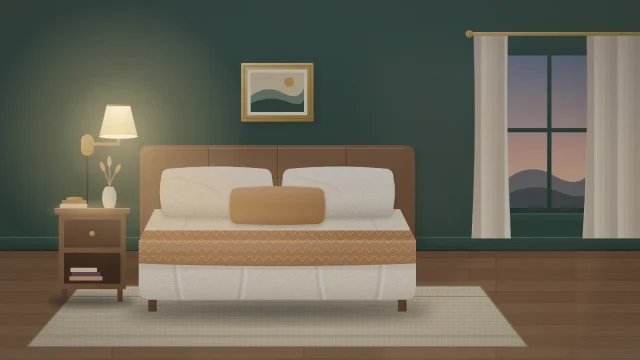
- One deep color all over. Deep green, navy or aubergine on walls and trim alike. With no contrast between surfaces, the corners fade and the room feels enclosed and deliberate. It does not look larger; it looks intentional. See the guide to dark colors in a small bedroom before you commit.
A deeper color on one wall
If you want depth without painting the whole room, one wall can carry it, usually the wall behind the headboard. Choose a deeper tone of the main color, not an unrelated one, so the contrast stays gentle. Which wall to pick and what to put on it is covered in small bedroom accent wall ideas.
How daylight shifts a color
The same paint looks different from room to room, and from hour to hour.
- Morning-sun rooms are warm early and flatter and cooler by afternoon.
- Evening-sun rooms are cool in the morning and glow orange late in the day, which can push a warm color toward peach.
- Rooms with little direct sun have steady, cooler light that grays colors down, so pick a shade slightly warmer and clearer than you think you need.
Surroundings count, too. An oak floor casts warmth up the walls, and a lawn or brick wall outside the window tints the light coming in. If you mostly use the room at night, judge the color under your lamps with warm white bulbs.
Test a sample before you commit
- Narrow the choice to two or three shades.
- Paint each on a white card about 12 x 12 in (30 x 30 cm), or on the wall itself if you are free to.
- Place one card beside the window and one on the opposite wall, where the light is weakest.
- Look in the morning, at midday and under lamp light.
- Hold your bedding and curtain fabric against each card.
- Wait two days before deciding. The shade that looks good at every hour wins.
Tip
If you rent, get permission before painting. If the answer is no, a palette still works: let the existing wall color be the main color and build the secondary and accent colors around it with bedding, curtains and a rug.
Frequently asked questions
What color makes a small bedroom look bigger?
Light, low-contrast colors do the most: warm whites, creams, pale sage and soft blue-grays. The shade matters less than keeping the walls, trim, curtains and large furniture close in tone, because sharp contrasts outline the room and show exactly where it ends.
Should the trim be the same color as the walls in a small bedroom?
Often, yes. Trim painted in the wall color, or one step lighter, removes a contrasting line around the doors, windows and baseboards. With fewer outlines to follow, the walls read as larger, calmer surfaces. Bright white trim against a mid-tone wall does the opposite.
How many colors should a small bedroom have?
Three is a reliable limit: a main color for the walls and largest textiles, a secondary color close to it for bedding or curtains, and one accent repeated in two or three small places. Wood tones and white usually sit quietly alongside without counting as extra colors.