How to Style Bedroom Shelves So They Look Curated
A seven-step method for bedroom shelves that look either bare or messy: clear, pick three colors, place anchors, build groups of three, mix book directions, add something organic and leave a third empty.
At a glance
What you need
- Eight to twelve books with calm spines
- One framed print that can lean
- A basket or lidded box that fits the shelf depth
- Three or four small objects of different heights
- One plant or a few dried stems
- A soft cloth for wiping the shelf
A bedroom shelf tends to fail in one of two ways. Either it holds three lonely objects spaced evenly like items in a shop window, or it has filled up with everything that had nowhere else to go. Both problems have the same fix: a short, repeatable order of work.
This is how to style bedroom shelves so they look curated, meaning chosen and edited, in seven steps. It works for a single shelf, a stacked pair or a narrow bookcase, and it relies mostly on things you already own.
What to gather first
Collect more than you will use, then edit. Put everything on the bed so you can see it together.
- Eight to twelve books, including a few with calm spines or attractive covers
- One framed print, roughly 8 x 10 in (20 x 25 cm), that can lean
- One basket or lidded box that fits the shelf depth
- Three or four smaller objects of different heights: a vase, a bowl, a small rechargeable lantern, a ceramic piece
- One plant, real or a good faux one, or a few dried stems
Choose a three-color thread
Before anything goes up, pick three colors and hold every object to them: one light neutral (white or cream), one material tone (wood, rattan or brass) and one accent taken from the bedding or curtains, such as sage or rust. A shelf is a small frame seen from a few feet away, and in a compact room it sits in the same view as the bed. Three colors that repeat make that view look planned. Six unrelated ones make it look like storage.
Books are usually the offenders. Turn the loudest spines to face the wall, remove bright dust jackets, or keep those titles elsewhere.
The seven-step method
- Clear the shelf completely. Wipe it down and look at the empty length. Rearranging around existing items only gives you the old arrangement again.
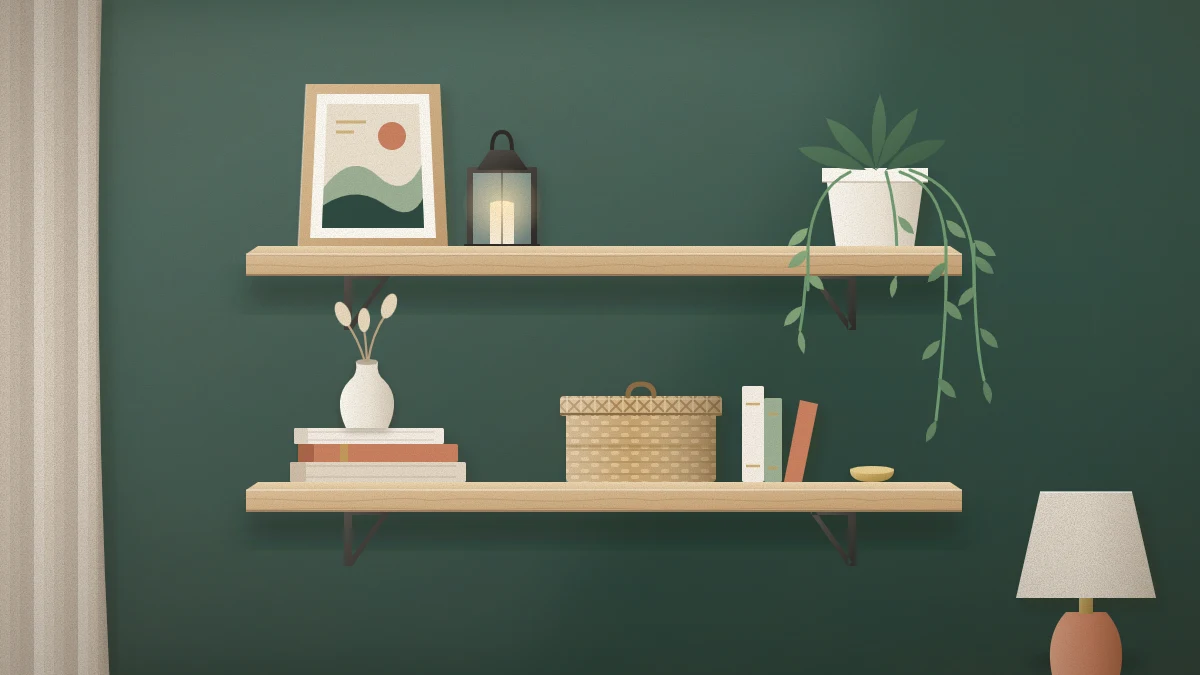
- Place the largest anchors. Set down the three biggest pieces first: the flat stack of books, the basket and the leaning print. Put them off-center and well apart, for example the print toward the left end and the basket toward the right. Anchors give the eye resting points, so the smaller things have something to relate to.
- Build groups of three. Around each anchor, add up to two smaller objects so each group steps down in height: tall, medium, low. A leaning print, a vase about half its height and a small bowl is a complete group. Overlap them slightly from front to back so they read as one cluster.
- Mix vertical and horizontal books. Stand five or six books upright, then lay three flat beside them or at the other end. The flat stack acts as a small pedestal for a vase or lantern, and the change of direction stops the shelf looking like a library row.
- Add one living or organic element. A trailing plant at a shelf end, a few dried grasses or a piece of driftwood softens all the straight edges. One per shelf is enough.
- Remove one thing. Step back to the doorway, pick the object you notice least and take it away. The arrangement nearly always improves.
- Protect the empty space. Aim to leave about a third of each shelf bare, in one or two clear stretches at least 6 in (15 cm) wide, not in thin slivers between every object.
Tip
Vary depth as well as height. Push one item to the back, pull another to about 1 in (2.5 cm) from the front edge. A shelf where everything lines up along the rear wall looks flat.
How to judge the result
Stand where you normally see the shelf from, often the doorway or the pillow, and check three things.
- Squint. You should see two or three dark shapes with pale gaps between them, not an even gray band.
- Trace the tops. The outline along the top of the objects should rise and fall. A straight line means the heights are too similar.
- Count the colors. If a fourth color jumps out, that object is the one to swap.
One shelf, a pair or a narrow bookcase
A single shelf
On a shelf about 24 to 36 in (60 to 90 cm) long, use two groups only, one larger than the other, with the open stretch between them. Three groups on a short shelf leave no room to breathe.
A stacked pair
Treat the two shelves as one composition and work in a zigzag. If the tall anchor sits at the left on the upper shelf, put the tall anchor at the right on the lower one. Repeat one material on both, such as a woven box above and a small rattan tray below, so they read as a set. Leave 12 to 15 in (30 to 38 cm) between the shelves so a leaning print has headroom.
A narrow bookcase
Books can take a larger share here, but alternate: one shelf mostly upright books, the next a flat stack and two objects. Give the bottom shelf to a basket or a pair of matching boxes, which adds visual weight low down and steadies the look of a tall, thin piece. The guide to decorative storage covers which baskets and boxes suit this job. Tall bookcases should be secured against tipping with the fittings supplied.
Keep it light and safe
Styling favors light objects anyway, which suits a wall shelf well. Keep what goes on it within what the shelf maker states, and put the heavier items, such as book stacks, on a bookcase or low down.
Safety note
If you are putting up a new shelf, use hardware rated for it and suited to your wall type, and follow the manufacturer instructions. A shelf above the bed should hold only lightweight, soft-edged items and be securely fixed; keep books, glass and ceramics off any shelf over the pillows.
Carry the look across the room
A styled shelf looks best when it echoes something nearby. Repeat its accent color on a throw pillow, and its metal or wood tone on the dresser, where the same anchor-and-group logic applies on a deeper surface; see how to arrange a dresser top.
If the shelf shares a wall with art, treat the two as one arrangement and keep the gap between them consistent, around 6 to 8 in (15 to 20 cm). There are more ways to combine shelves, prints and ledges in these wall decor ideas for a small bedroom.
Frequently asked questions
How much of a shelf should be left empty?
About a third is a useful target. Gather that empty space into one or two clear stretches at least six inches wide instead of spreading thin gaps between every object. Grouped negative space is what makes the arrangement look edited, and it keeps a small bedroom wall from feeling crowded.
Why do groups of three work on a shelf?
Three objects of different heights form a small triangle, so the eye moves across the group and treats it as one shape. Two matching items look static, and four or more start to read as a row. Stepping from tall to medium to low gives each cluster a clear outline.
Can I style a shelf above the bed?
Yes, with restraint. Keep to lightweight, soft-edged pieces such as a small faux plant, a paper or fabric item and an unglazed print, and make sure the shelf is securely fixed with hardware suited to the wall. Leave books, glass and ceramics for a shelf elsewhere in the room.