How to Refresh a Small Bedroom With What You Already Have
An eight-step afternoon method for making a small bedroom look new without buying anything: clear the surfaces, re-center the bed, borrow from other rooms and restyle.
At a glance
What you need
- A laundry basket or large box
- A tape measure and painter's tape
- A damp cloth
- Clean bedding
- A lamp, throw, mirror and print borrowed from other rooms
- A phone camera for before and after views
After a year or two you stop seeing your own bedroom. The lamp sits where it landed on moving day, the same three things live on the nightstand, and the print over the dresser might as well be part of the wall. Nothing is wrong, but nothing looks chosen any more.
You can refresh a small bedroom in one afternoon without buying anything, because most of what makes a room look new is position and grouping, not objects. The method below works through the room in a fixed order: clear, look, move, borrow, rebuild, then take a little away.
What to Gather Before You Start
- A laundry basket or large box for everything that comes off the surfaces
- A tape measure and a roll of painter’s tape
- A damp cloth, since cleared surfaces show dust
- Clean bedding, ironed or freshly out of the dryer if possible
- Your phone camera, for before and after views from the door
Work in daylight, because you will be judging color and shadow.
The Refresh, Step by Step
- Take a photo from the doorway, then empty the surfaces. Clear the nightstand, dresser top, shelves and windowsill into the basket. Take leaning or easily lifted art down too. Leave furniture where it is for now.
- Stand in the doorway and look for one minute. Note what your eye lands on first. In a small room it should be the bed, or the bed plus what is above it. If it is the side of a dresser, a tangle of cords or a laundry hamper, that is the thing to fix.
- Re-center the bed, or try it on one other wall. Measure the wall and place the bed so the space on each side is equal, even if that is only 12 in (30 cm). If another wall is long enough, mark the bed’s footprint there with painter’s tape before lifting anything. Keep doors, vents, radiators and heaters clear, and leave a path of about 24 in (60 cm) where you walk most. The guide to small bedroom furniture placement helps if the dresser then needs a new spot.
- Shop the rest of your home. Walk through every other room looking for four things: a lamp, a throw, a mirror and one piece of art. A living-room lamp with a fabric shade, a hallway mirror or a print from the stairs will look new here simply because you have never seen it in this room.
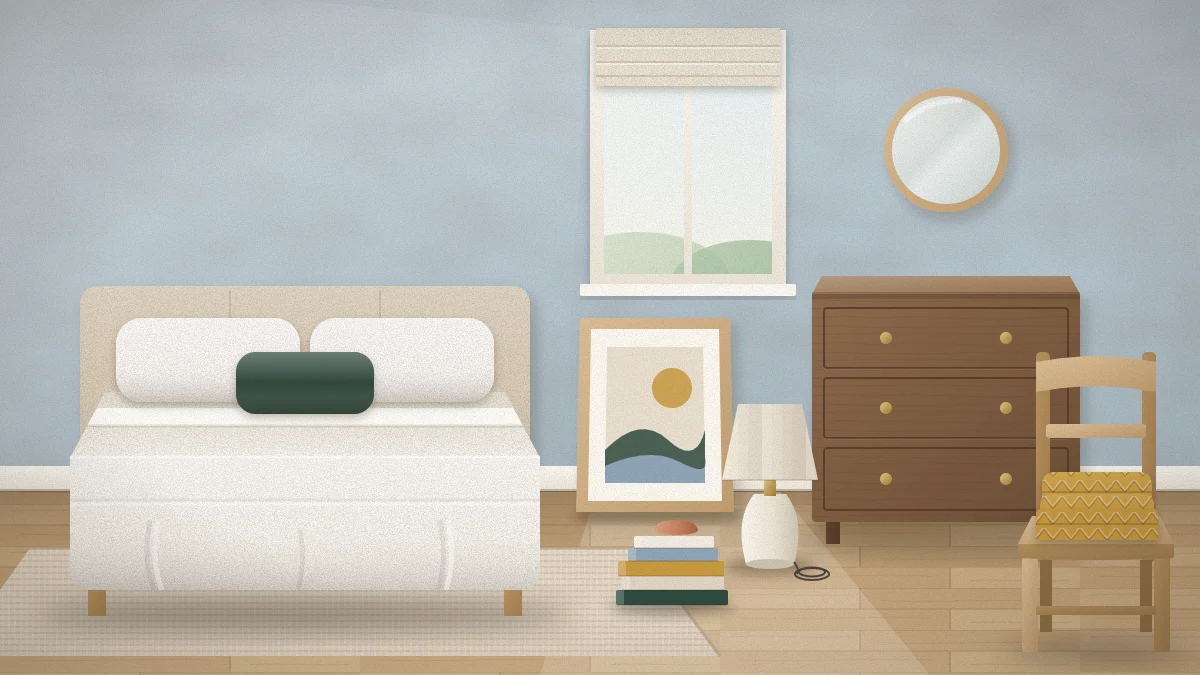
- Remake the bed as the focal point. Use the clean bedding, pull the duvet cover smooth and fold the top down by about a third so the sheet shows as a contrasting band. Stand the sleeping pillows upright and put one or two cushions in front. Fold the borrowed throw across the foot. For the full order of layers, see how to layer bedding.
- Regroup the surfaces, one at a time. Return only part of what was in the basket. On the nightstand: the lamp, one tall thing such as a small vase, and a dish for small items, with about a third of the top left empty. On the dresser: a taller object at one end, a low group at the other, a stack of two or three books between. There is a simple formula for the first of these in the guide to bedside table styling.
- Rehang or lean the art. Art that hung at standing eye level often looks better lower. The center of a piece about 57 in (145 cm) from the floor is a common starting point, or 6 to 8 in (15 to 20 cm) above a dresser top. Leaning a frame on the dresser against the wall is quicker and lets you overlap a smaller frame in front.
- Remove a few things, then photograph again. Take away three objects you just placed, the ones you would not miss. Compare the new photo with the first one.
Safety note
A borrowed floor mirror that leans against the wall should be secured against tipping. Anything you rehang above the bed should be lightweight and securely fixed, with hardware suited to your wall and the piece. Keep lamps and their cords clear of curtains and bedding.
How to Judge the Result
Put the two doorway photos side by side and check four things.
- One focal point. Your eye should go to the bed first and then travel to one or two other spots, not bounce between eight.
- Visible floor. You should see at least as much floor as before. If you see less, something moved into a sightline.
- Empty space on every surface. Each surface should have a clear patch at least the size of your hand.
- A repeated color. One accent color should appear in three places, such as a cushion, a book spine and a print.
If the Bed Cannot Move
In many small rooms the bed fits on exactly one wall. Skip the second half of step 3 and change what surrounds the bed instead. Swap the nightstand to the other side, or replace it with a stool or chair from another room. Turn the rug a quarter turn, or slide it so more shows on the side you step out on. Move the lamp from the dresser to the bedside.
Variations by Bed Size
Twin bed against a wall: treat the long wall side as a back. Line two or three cushions along it so the bed looks like a daybed, and put the borrowed lamp at the head end only.
Full or queen bed with space on both sides: aim for symmetry in position and variety in objects. Two different nightstands of similar height, each with a lamp, look more interesting than a matched pair and use what you have.
Queen bed that nearly fills the room: put all the effort into the bed and the wall behind it. Borrow the best throw and the best piece of art in your home, and leave the other walls plain.
What This Exercise Is Not
The basket of leftover objects is not a sorting project. Put it in a closet and decide later. The afternoon is about how the room looks from the door, and stopping to file things breaks the momentum.
If the result shows a gap that no borrowed object could fill, such as a bare window or a flat bed, write it down. A short list of low-cost updates for a small bedroom is the natural next step, and you will now buy for a specific spot.
Frequently asked questions
How long does it take to refresh a small bedroom this way?
Most people can work through all eight steps in a single afternoon, roughly two to four hours. Moving the bed to a different wall adds time, and so does washing and drying bedding beforehand. If you are short on time, do the clearing, the bed and the nightstand, and leave the art for another day.
What if there is nothing in the rest of the home worth borrowing?
Then work with position alone. Swap the nightstand to the other side, turn the rug, move the lamp, and regroup what was already in the room into fewer, tighter clusters. Removing a third of what was on display often changes the room as much as adding something would.
Should the furniture move every time?
No. If the bed is already centered on the best wall and the view from the door lands on it, leave the layout alone and put the effort into the bed, the surfaces and the art. Moving furniture is worth it only when the doorway view shows a problem.