Small Bedroom Decor Ideas: Where to Start in a Compact Room
A starting order for decorating a compact bedroom: layout, a three-color palette, the bed as focal point, one dressed wall, softer light and a few larger details, with the reason each step comes where it does.
A compact bedroom leaves little room for trial and error. Every piece is visible from the door, a rushed purchase shows, and three unrelated fixes rarely add up to a room that looks finished. Most small bedroom decor ideas are sound on their own; what usually goes wrong is the order they are tried in.
The sequence below runs from the decisions that are hardest to undo to the ones you can change in an afternoon: layout, palette, the bed, the walls, lighting, then the last details. Settle each before moving on and the later choices get easier, because each one has less to compete with.
Why fewer, larger gestures read better
In a room of about 10 x 10 ft (3 x 3 m), your eye takes in everything at once. Twelve small objects register as twelve separate things to look at, so the room feels busy and tighter than it is. One print of about 24 x 36 in (60 x 90 cm), one generous rug and one substantial lamp register as three things, with calm wall and floor between them.
That calm area is negative space, and it is what makes a small room look composed instead of crowded. The working rule for every step below follows from it: choose one larger piece over several small ones, and leave the area around it empty.
1. Fix the layout before anything else
The position of the bed decides where the art, the rug and the lamps go. Decorate around a bed that sits on the wrong wall and you will do the work twice.
As a starting point, try the bed on the longest uninterrupted wall, ideally where the headboard is the first thing you see from the door. Keep a path of roughly 24 in (60 cm) on the side you get in and out of, let the door and closet open fully, and never block a vent, a radiator or a window you would need as an exit. Marking furniture footprints on the floor with painter’s tape shows the result before you lift anything. For the realistic options, compare these six layouts for a small bedroom.
2. Choose a restrained palette
Pick three colors before you buy a single cushion: a main color for the walls and the largest textiles, a secondary color for most of the bedding and the curtains, and one accent that appears in two or three small places. Warm white walls, oatmeal bedding and a clay accent is one example.
The reason is contrast. Where two very different tones meet, your eye sees an edge, and edges show exactly how close the walls are. When the walls, curtains and bed sit near each other in tone, those edges soften and the room reads as one continuous space. The guide to palettes that open up a small bedroom walks through six combinations. If you rent, get permission before painting; bedding, curtains and a rug can carry a palette on their own.
3. Make the bed the focal point
A full mattress, about 54 x 75 in (137 x 190 cm), covers more than a quarter of a 10 x 10 ft floor. It will dominate the room whatever you do, so make that deliberate.
- Give it a headboard. One that rises about 20 to 24 in (50 to 60 cm) above the mattress anchors the bed to the wall and gives the eye a place to land.
- Keep the bedding to two colors. As the biggest surface in the room, the bed looks calmer in solids or a fine texture than in a large print.
- Limit the pillows. Two sleeping pillows, two cushions and one throw folded across the foot look finished without burying the bed.
4. Dress one wall and leave the others quiet
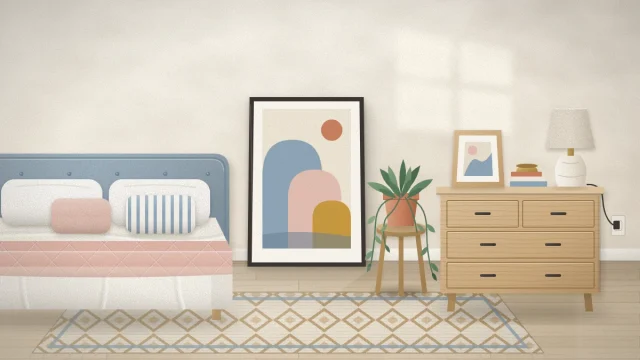
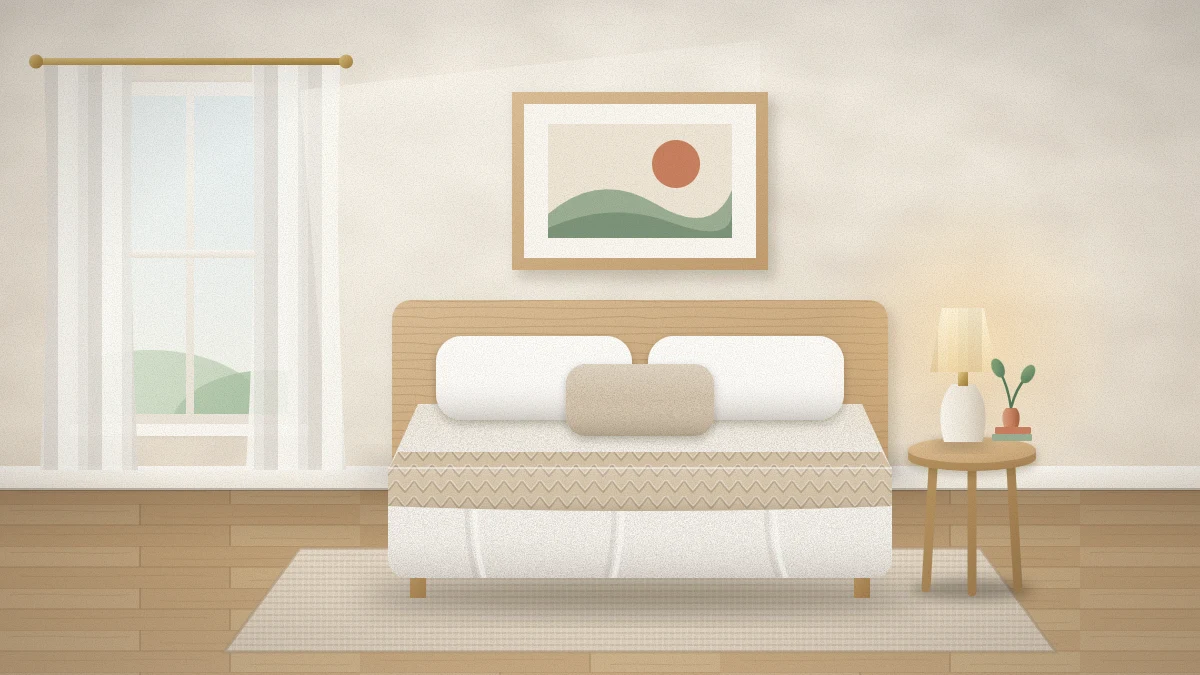
The headboard wall is the natural one to decorate, because you already look there. One piece roughly two thirds the width of the bed, about 36 in (90 cm) wide over a full, has more presence than five small frames and leaves the wall around it clear.
On the remaining walls, add only what does a job. A mirror placed to catch the window brightens the room, and curtains hung high make the wall look taller; both are covered in the guide to making a small bedroom look bigger. At least one wall should stay bare. It gives the decorated one something to stand out against.
Safety note
Anything hung above the bed should be lightweight and securely fixed, with hardware rated for the piece and suited to your wall type. Follow the manufacturer instructions, and skip heavy mirrors and glass-fronted frames directly over the pillows. A leaning floor mirror should be secured against tipping.
5. Soften the lighting
A single ceiling light flattens everything and leaves the corners in shadow, which pulls the walls inward at night. Two or three low sources do the opposite. A plug-in lamp on the nightstand and a second on the dresser, both with fabric shades and warm white bulbs, wash light across the walls so the corners stay visible and the room keeps its full size after dark.
Choose lamps as objects, too. One ceramic base about 16 to 20 in (40 to 50 cm) tall does more for a nightstand than several small ornaments. Keep lamps and bulbs clear of curtains and bedding.
6. Finish with a few details
Only now add the small things, and fewer than you think: a rug large enough to run under the lower part of the bed, one plant about 12 to 18 in (30 to 45 cm) tall, a tray that gathers what lives on the nightstand, a basket for the spare throw. Repeat your accent color in two of them so they look related.
Then stand in the doorway and remove one thing. If the room still feels off, the list of decorating mistakes that shrink a small bedroom helps you find the cause.
If you only have a little time
| Time you have | Do this | Why it comes first |
|---|---|---|
| One hour | Clear every surface, then put back three items per surface at most | It creates negative space at no cost |
| An afternoon | Test the bed on its best wall and re-center the art over it | Everything else is positioned from the bed |
| A weekend | Bring bedding and curtains into one three-color palette | Textiles are the largest areas of color after the walls |
Frequently asked questions
What should I decorate first in a small bedroom?
Start with the layout, because the position of the bed decides where the rug, the art and the lamps belong. Once the bed is on its best wall, choose a three-color palette, then dress the bed. Wall decor, lighting and accessories come last, since they are the easiest to change.
How many decorative items should a small bedroom have?
There is no fixed number, but a useful limit is one main piece per wall and about three items per surface. A few larger objects with empty space around them look calmer than many small ones, because the eye reads each object as a separate thing to take in.
Can I decorate a small bedroom without painting?
Yes. Bedding, curtains and a rug are the largest areas of color after the walls, so they can set the palette by themselves. Keep them within two or three related tones, add one accent color in small touches, and the room will look planned even with plain rental walls.