Small Bedroom With a Desk: Layouts for a Sleep and Work Corner
Four places a desk can go in a small bedroom, the sizes that fit, and how to separate the work corner visually so the room still feels like a bedroom.

A desk is the hardest piece to add to a bedroom, and not because of its size. A slim desk takes less floor than most dressers. The difficulty is that a work surface brings a screen, a chair and paper with it, and in a small bedroom with a desk those things sit in view of the pillow.
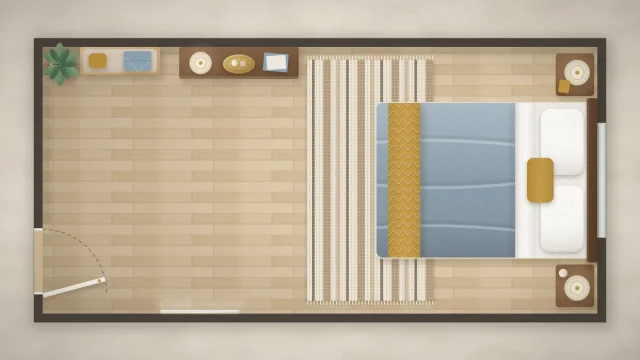
So the layout has two jobs. The desk needs a position where the chair can pull out without blocking the room, and the room needs a clear visual signal that one part is for sleeping and the other is for work, with the bed still the first thing you notice from the door.
Sizes that fit a small bedroom
A standard desk is around 24 in (60 cm) deep and 48 in (122 cm) wide, which is more than a laptop needs. For a small room, look for a top about 16 to 20 in (40 to 50 cm) deep and 30 to 40 in (76 to 100 cm) wide. Choose open legs over a solid pedestal: floor that stays visible under the desk makes it read as lighter than its footprint.
Behind the desk edge, a chair needs roughly 30 in of free floor to pull out and sit down. A stool or armless chair that slides fully under the top can manage with about 24 in. Both figures are rules of thumb; tape the chair’s pulled-out position on the floor before you commit.
Four places the desk can go
1. In place of a nightstand
Set the desk against the headboard wall, beside the bed, and let it do the nightstand’s work as well. This is the most economical placement because it removes one piece of furniture instead of adding one. Push the chair in at night and the near end of the desk takes the lamp, a book and a glass of water.
Keep the top close to mattress height, or a little above, so the line across bed and desk stays calm.
2. Under the window
Daylight at the desk is the main reason to choose this spot, and it uses a wall where tall furniture cannot go. A top at about 29 to 30 in (74 to 76 cm) usually sits below the sill. Sitting sideways to the glass keeps glare off a screen better than facing it.
Leave it out if a radiator or vent sits under the window, and keep curtains hanging clear of the desktop and any lamp.
3. At the foot of the bed
A narrow desk backed up to the foot of the bed, with the chair facing the bed, turns the mattress into a visual divider. From the pillow you see the low back of the desk, not the work on it. You need the desk depth plus chair room between the bed and the opposite wall, so around 50 in (127 cm) in total. In a shorter room, turn the desk to face the wall instead and let the chair back onto the bed end.
4. A slim ledge along a wall
Where no floor is left, a ledge-style desk about 12 to 16 in (30 to 40 cm) deep and 36 in (90 cm) or more long can run along a free wall, either as a narrow console on legs or as a wall-mounted top. It is enough for a laptop and a notebook, and it barely interrupts a walkway.
Safety note
A wall-mounted desk or shelf needs hardware rated for the piece and suited to your wall type; follow the manufacturer instructions and keep what goes on it within what the maker states. If you are unsure what is behind the wall, ask a professional. Renters should get permission before fixing anything to a wall.
The four placements compared
| Placement | Floor it takes | Best when | Watch for |
|---|---|---|---|
| As a nightstand | Least; replaces a piece | The headboard wall has spare width | Work in view from the pillow |
| Under the window | Desk plus chair room | You work in daytime | Radiators, vents, long curtains |
| Foot of the bed | Most depth | The room is long | The walkway to the far side |
| Wall ledge | Very little | Laptop-only work | Wall fixing and a shallow top |
If the desk competes with a dresser for the same wall, the guide to placing the dresser, desk and chair explains how to decide which piece gets it.
Draw a line between sleep and work
The two zones need not be far apart. They only need to look different. One or two of these signals is enough; using all four makes a small room look busy.
- A rug edge. Let the bedroom rug stop short of the desk so the chair stands on bare floor. The change of surface underfoot marks the boundary without any object in the way.
- A change of lamp. Give the desk a focused task lamp with a metal or directional shade and the bed a soft fabric shade. At night, the desk lamp goes off and that corner recedes. See the bedroom lighting guide for plug-in options that leave the desktop free.
- A different wall color. A painted block slightly wider than the desk, one or two tones deeper than the walls, frames the work corner as its own place. Ask before painting if you rent.
- An art grouping. Two or three small frames in a tight cluster above the desk give it a center of its own, while the bed keeps the single largest piece in the room.
Keep the desk calm so the bed stays the focal point
An open desk covered in cables and paper has more visual weight than a made bed, and the eye goes to it first. The fix is to limit what stays out, not to style it more.
- Choose a desk with one drawer, or add a lidded box, so work disappears when it is finished. Closed storage reads as one shape; open stacks read as many.
- Keep a single tray for the things that live on top: pens, a charger, glasses. Everything outside the tray goes away.
- Close the laptop and stand it in a file holder, or lay a linen cloth over a monitor in the evening.
- Match the desk finish to the nightstand or bed frame so it belongs to the bedroom set.
A single shelf above the desk can take over from a cluttered top, provided it is arranged with air around the objects; the method for styling bedroom shelves applies here too.
Frequently asked questions
What size desk fits in a small bedroom?
A top roughly 16 to 20 inches deep and 30 to 40 inches wide is enough for a laptop and a notebook and takes less floor than most dressers. Allow about 30 inches behind it for a chair, or a little less for a stool that slides completely underneath.
Can a desk replace a nightstand?
Yes, and it is often the most space-efficient choice. Place the desk against the headboard wall next to the bed, keep the end nearest the pillow for a lamp and a book, and push the chair in at night. A desk close to mattress height looks most settled.
How do you keep a bedroom desk from looking like an office?
Limit what stays on the surface to a lamp, one tray and one soft object, and put the rest in a drawer or a lidded box. Pick a chair that looks like bedroom furniture, match the desk finish to the bed frame or nightstand, and give the desk a different lamp from the bedside one.