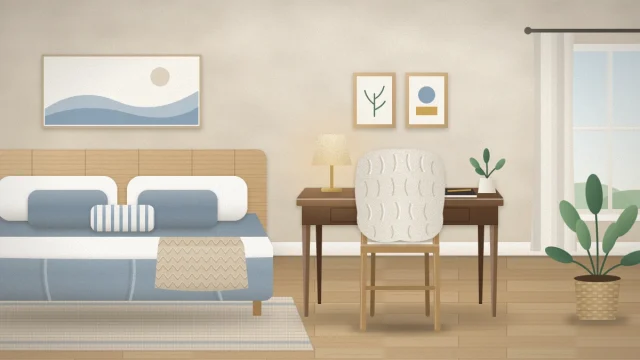
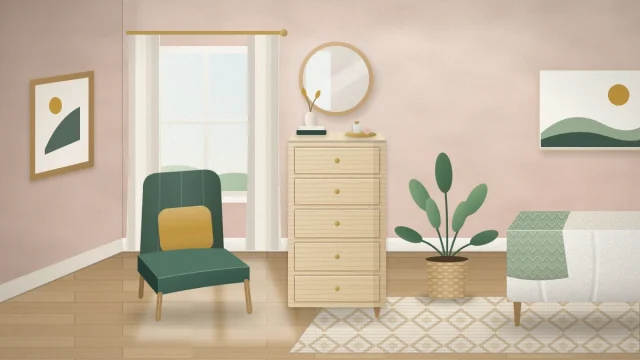
Long Narrow Bedroom Layout: How to Arrange a Tight Room
Two arrangements that work in a corridor-shaped bedroom, plus the rug, paint, mirror and lighting moves that stop it from feeling like a hallway.

Picture a room about 8 ft wide and 14 ft long (2.4 x 4.3 m), with the door at one end and the window at the other. Push a bed against one long wall and a dresser against the other, and what you get is a hallway with a mattress in it. The room is not too small. Its proportions are doing the damage, because every line in it points the same way.
A good narrow bedroom layout does two things: it keeps one clear path along a single side, and it adds lines that run across the width so the eye stops traveling straight to the far wall. There are two arrangements that manage both.
Arrangement one: bed across the short end wall
Set the head of the bed against the far end wall so the mattress spans the width of the room. A queen is about 60 in (152 cm) wide, so in an 8 ft room it leaves roughly 18 in (45 cm) on each side: tight, but enough to get in and make the bed. A full, at about 54 in (137 cm), leaves a little over 20 in a side.
This works because the bed fills the end of the tunnel with a wide, low shape. The room now looks like a sleeping end and a clear front area instead of one long strip, and everything between the door and the foot of the bed is free for a dresser and a chair along one wall.
If the window is on that end wall, a low headboard below the sill keeps the glass clear. The guide on where to put the bed covers the under-window details. Keep any window you would use as an exit easy to reach, and keep bedding away from a heater or radiator below it.
Arrangement two: bed lengthwise on a long wall
When the room is too narrow for arrangement one, or a door or closet sits in the end wall, turn the bed so one long side runs along a long wall. A queen then projects about 60 in into the room and leaves roughly 36 in (90 cm) of walkway in an 8 ft room. In a 7 ft (2.1 m) room, a full leaves about 30 in (76 cm), which is still comfortable to walk.
The cost is that one sleeper climbs in from the foot or across the bed, so this suits one person better than two. Dress it like a daybed: a row of cushions along the wall side makes the placement look chosen. Then put the dresser on the same wall as the bed, beyond its foot, so the opposite wall stays empty.
| Question | Bed across the end | Bed along the long wall |
|---|---|---|
| Room width it needs | About 8 ft or more for a queen | Works from about 7 ft |
| Access to the bed | Both sides, narrowly | One side and the foot |
| Free floor | One open area near the door | One long strip beside the bed |
| Best for | Two sleepers | One sleeper, or a very tight room |
Keep one path, on one side
Whichever arrangement you choose, line the furniture up on a single long wall and leave the other one bare from the door to the far end. A comfortable minimum for that path is around 24 in (60 cm), and about 30 in feels easy; these are rules of thumb, not standards.
The reason is simple arithmetic. A dresser 18 in deep on each long wall takes 36 in out of a 96 in room and leaves a slot between two rows of furniture. The same two pieces on one wall take 18 in once. Choose shallow pieces, about 14 to 16 in (35 to 40 cm) deep, and vary their heights so the wall does not read as a single shelf.
Break the tunnel with lines across the width
Three moves interrupt the long view. You rarely need all of them.
- A rug laid across the room. Turn the rug so its long side runs wall to wall instead of down the length. A stripe that crosses the width works especially well, since each band is a line pushing the walls apart. For sizes, see the rug placement guide.
- Horizontal stripes in the textiles. A striped duvet cover or a folded throw across the foot of the bed adds more cross lines at low cost.
- A painted end wall. A deeper, warmer tone on the far short wall makes it seem to step toward you, which visually shortens the room into a better proportion. Leave the long walls pale so they fall back. If you rent, get permission before painting.
Put a mirror on the long wall
A mirror on a long wall reflects the opposite wall and reads as extra width. The same mirror on the end wall would reflect the whole length back at you and double the tunnel. Hang it on the bare long wall, roughly at the midpoint, or lean a tall one there if the path allows.
More on what a mirror should reflect is in the guide to placing mirrors in a small bedroom.
Safety note
Hang a wall mirror with hardware rated for the mirror and suited to your wall type, and follow the manufacturer instructions. A leaning floor mirror should be secured against tipping, especially beside a walkway.
Spread the light along the length
A single ceiling light in the center leaves both ends dim, which makes a long room feel even longer and darker at the far wall. Use three smaller sources at different points instead: a lamp near the door end, one beside the bed, and one at the far end or on the dresser between them.
Light the end wall deliberately, because a bright far wall looks closer than a shadowed one. Keep cords along the baseboard and out of the path, and keep lamps clear of curtains and bedding.
What to avoid in a narrow room
- Furniture on both long walls. It narrows the floor to a corridor and doubles the lines running lengthwise.
- A runner down the middle. It works like an arrow pointing at the end wall.
- Tall pieces at the door end. They narrow the entry and block the view. Put height at the far end, and secure tall furniture against tipping.
- Anything in a door swing or over a vent.
Frequently asked questions
Where should the bed go in a long narrow bedroom?
Across the short end wall if the room is wide enough to leave a narrow strip on each side of the mattress, because the bed then closes off the tunnel. In a tighter room, run the bed lengthwise against one long wall and keep the walkway on the other side completely clear.
How do you make a narrow bedroom look wider?
Add lines that run across the width and remove lines that run down the length. A rug turned crosswise, a striped throw, a mirror on a long wall and a deeper color on the far end wall all help. Keeping furniture to one long wall leaves the widest possible strip of visible floor.
Which way should a rug go in a long narrow room?
Lay it across the room, with its longer side running from one long wall toward the other, usually under the lower part of the bed. A runner laid down the center does the opposite: it repeats the direction of the room and leads the eye straight to the end wall.