Where to Put the Bed in a Small Bedroom
A step-by-step way to choose the wall for your bed: the longest clear wall, the view from the door, the window, door and closet swings, and heat sources, plus how to handle a corner or under-window position.

One awkward room, one bed, and four walls that each seem to have something wrong with them: a door here, a window there, a closet that needs to open. Deciding where to put a bed in a small bedroom is mostly a process of elimination, and it goes faster when you take the questions in a fixed order.
Work through the five checks below with a tape measure. By the end, most rooms have one clear answer and one runner-up. The last two sections deal with the compromises small rooms force most often: the corner and the window.
1. Find the longest uninterrupted wall
Measure each wall between its interruptions: door frames, closet openings, windows and radiators. The longest clear stretch is your first candidate for the headboard.
Then compare it with the bed. A twin is about 38 in (97 cm) wide, a full about 54 in (137 cm) and a queen about 60 in (152 cm); a table of standard bed sizes lists the rest. Add roughly 24 in (60 cm) for each side you want to walk along. A queen with access on both sides needs about 9 ft (2.7 m) of clear wall. If the stretch is only 7 ft (2.1 m), the same bed fits with one walkway, which means one side goes against a wall.
2. Check the view from the door
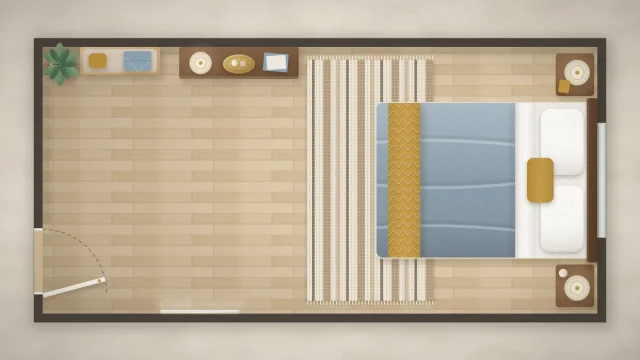
Stand in the doorway and picture the bed on each candidate wall. The best position shows you the headboard and the made bed first, on the wall opposite the door or diagonal to it. That makes the bed the focal point and leaves open floor in front of you, so the room looks larger on entering.
The weaker positions put the side or foot of the bed just inside the door, where you walk straight into it. If the bed has to share a wall with the door, try to keep about 30 in (75 cm) between the door frame and the mattress, and make sure the door opens fully.
3. Decide how the bed relates to the window
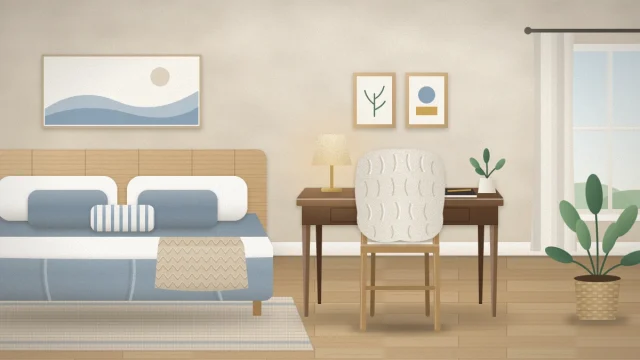
- Beside the window is usually best. Daylight comes across the bed from the side, the window stays easy to reach, and the headboard gets a solid wall behind it for art.
- Partly in front of the window works when the headboard is low or open, such as a slatted or metal frame, so light still passes. Center the bed on the window if you can; a headboard that overlaps one third of the glass looks accidental.
- Under the window is the fallback, and it can look very good. It has its own section below.
Whichever you choose, do not block a window you would need as an exit.
4. Clear the door and closet swings
Open every door fully and note the arc on the floor. The bed should sit outside each one. A hinged closet door needs its own width in clear floor, plus room for you to stand, so allow roughly 30 to 36 in (75 to 90 cm) in front of a closet. Sliding and bifold doors need less. Check dresser drawers the same way if the dresser is already in place.
5. Keep vents, radiators and heaters clear
Look down as well as across. A bed pushed over a floor vent blocks the airflow the room depends on, and a headboard against a radiator traps its heat behind the bed.
Safety note
Never place a bed against a radiator, baseboard heater or portable heater, and keep bedding and curtains well away from any heat source. Follow the clearance in the heater’s own instructions.
Centered or pushed into a corner?
A centered bed with a nightstand on each side looks balanced and lets two people get in and out. It is the right choice when the wall allows it. When it does not, a corner bed gives back a block of floor about 24 to 30 in wide, often enough for a dresser or a chair. For how both arrangements fit into a whole room, see these small bedroom layout ideas.
A corner bed looks like a last resort only when it is left undressed. Three moves make it look deliberate:
- Cushions along the side wall. Three cushions about 20 to 22 in (50 to 55 cm) square, or one long bolster, turn the wall side into a back, so the bed reads as a daybed.
- A light on the wall side. A plug-in wall light about 20 to 24 in (50 to 60 cm) above the mattress replaces the nightstand lamp that has nowhere to stand. Fix it with hardware suited to your wall, follow the manufacturer instructions and keep the shade clear of pillows and bedding.
- A rug offset toward the open side. Slide the rug so it shows along the open side and the foot instead of centering it under the bed, where half would be hidden against the wall.
Center any art on the bed, not on the wall, so the two read as a pair. Keep it lightweight and securely fixed; the guide to what to hang over the headboard covers sizes and safe choices.
When the only option is under the window
In many small rooms the window wall is the only one without a door in it. If the bed has to go there, make the window part of the composition.
- Choose a low headboard. Measure from the floor to the sill and pick a headboard that stops at or just below it, so no glass is covered. An upholstered one is comfortable to lean on.
- Center the bed on the window. The window then acts as the art, and the wall needs nothing else.
- Swap long curtains for a shade. A roman or roller shade fitted inside the frame works without reaching behind the pillows and leaves no fabric bunched at the headboard.
- Keep it practical. Make sure you can still reach the latch, and leave a small gap between mattress and wall if a baseboard heater or vent sits below the sill.
In a corridor-shaped room, the window is often on the short end wall, and a bed set across it can be the best layout available. The long narrow bedroom layout guide explains when that works.
Tip
Before moving the bed, tape its outline on the floor in the new position and leave it for a day. Walk to the closet and open every door before you lift anything.
Frequently asked questions
Is it bad to put a bed under a window?
No. It is a common and good-looking solution when no other wall is long enough. Use a headboard that stays at or below the sill, fit a shade inside the frame, and keep the window reachable. Avoid it only if the bed would block an exit window or sit against a heater.
Should a bed face the door in a small bedroom?
It helps if you can see the headboard from the door, because the bed then becomes the focal point and the floor in front of you stays open. The bed does not need to face the door exactly; a wall opposite or diagonal to the doorway both work well.
Which side of the bed should go against the wall?
Put the side you use least against the wall and keep the open side toward the door or the closet, so your daily route stays short. If the room has a window on one side, leaving that side open also keeps the window easy to reach.